A week solo between the mountains of the Caucasus and the cobbled streets of Tbilisi, with a band of travel companions picked up along the way — a Spanish blogger and a Pole traveling by motorbike — who keep turning up day after day like an unexpected common thread.

Day 1

Arriving in Tbilisi, first steps in the old town

Flight booked two days before leaving. Landing in Tbilisi, and a surprise when I ask whether there’s a bus to the center: by some miracle, the answer is yes — for barely 50 tetri (the subunit of the Georgian lari), about 20 euro cents a ride. The area around the bus station doesn’t look very inviting, so I take the same bus back to a neighborhood I’d spotted in advance, where I find a hostel at 10 lari a night. A short wander through the lanes, a stop in a park of no particular interest but full of everyday scenes: older locals playing dominoes, a 2-lari beer on a terrace, the quiet Sunday atmosphere. I think about what comes next: heading for the Kazbegi region, to Stepantsminda to be exact — a small town tucked into the mountainous north of the country, right by the Russian border. It’s the most accessible of the places that tempt me, and I don’t have time to go farther.
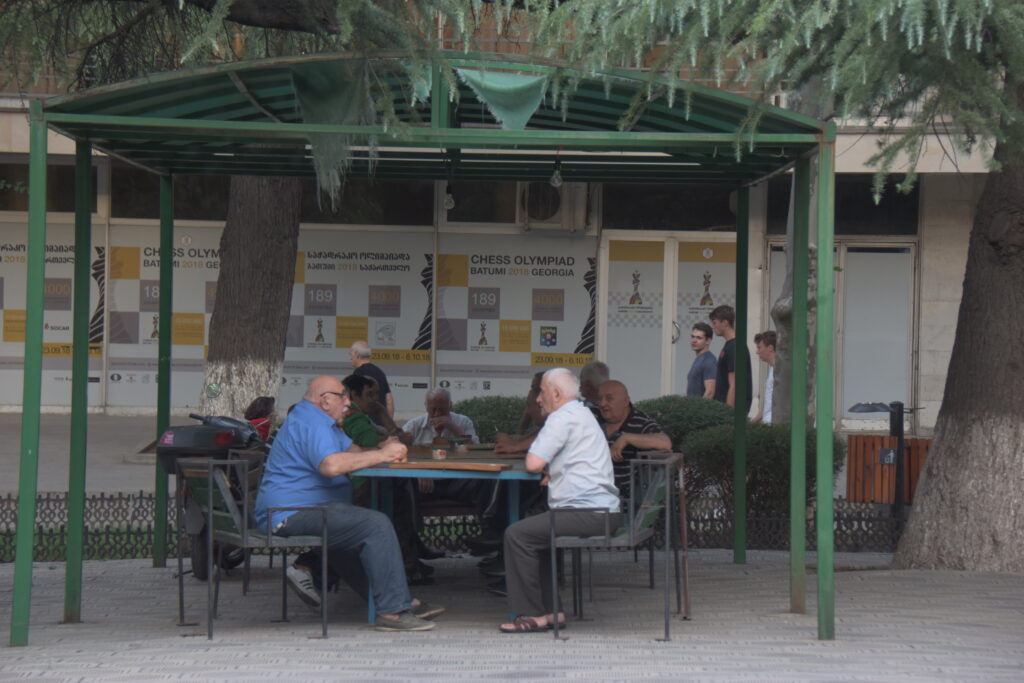
Older locals playing dominoes under a park pavilion in Tbilisi, Georgia
Day 2

A chaotic wake-up and the road to the mountains

The hostel manager sleeps in the same dorm as me — his phone rings at 5 a.m. without him so much as stirring, until an exasperated Frenchman gets up to wake him. The same scene plays out several times: he wakes up for two minutes, falls back asleep… He eventually goes out for a smoke, leaving the door wide open onto a street that’s already busy. Up for good around 10 a.m.

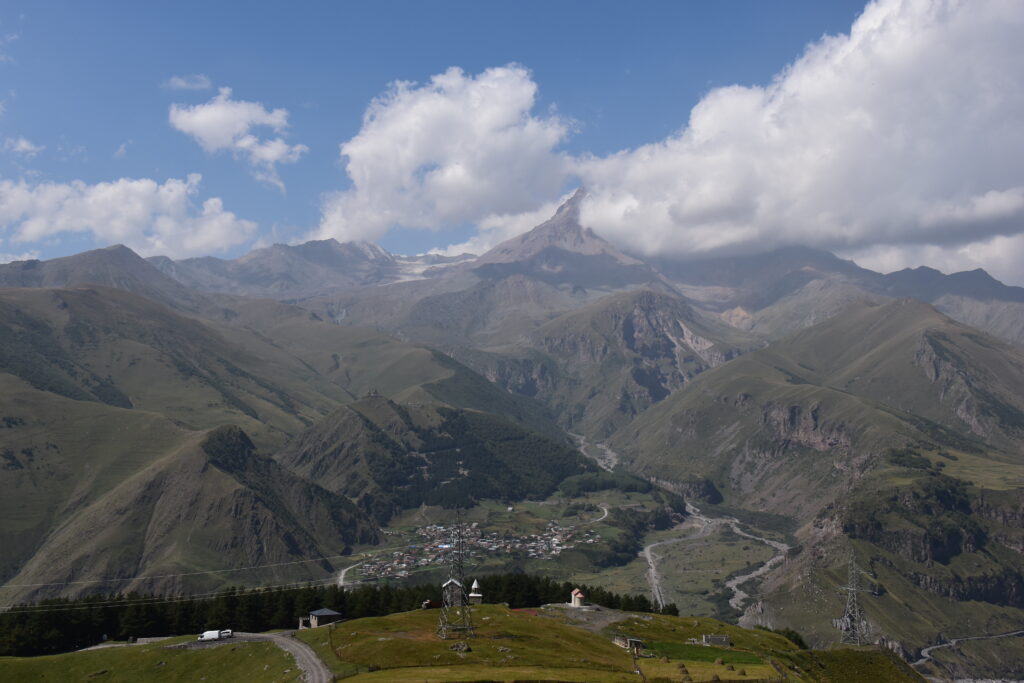
Off to Didube bus station by metro, then a marshrutka (the Georgian shared minibus) — the metro goes through a particularly deep station, almost comical compared with Dubai’s, or even Paris’s. About three hours on the road for 10 lari, with scenery that keeps getting more beautiful the closer we get. Arrival in Stepantsminda (1,740 m above sea level), a breathtaking setting in the middle of the mountains. A basic hostel at 15 lari a night, booked for three nights: I walk straight into a room by the entrance that serves as living room and kitchen, door wide open, the other room serving as a dorm with five single beds, nothing more — and not a trace of a receptionist, just a WhatsApp number to message to book your bed and pay. A bit of information-gathering on the hiking trails, then a stroll around the village.
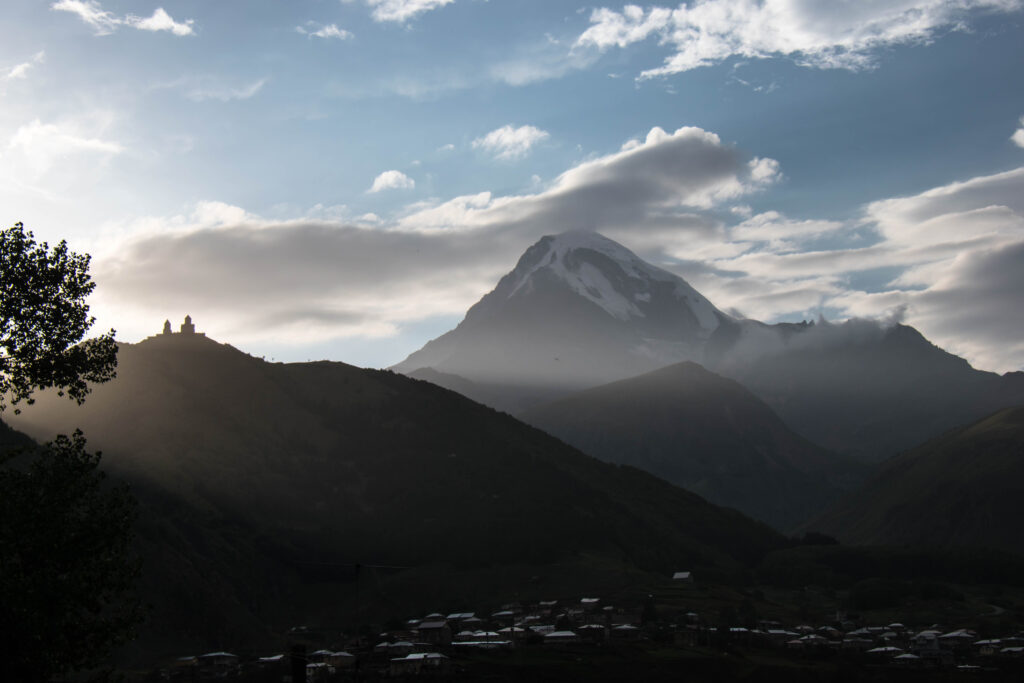
Mount Kazbek’s peak in the clouds above Gergeti Trinity Church, Kazbegi region
View of Mount Kazbek and Gergeti Trinity Church
Day 3

Toward the glacier, at the foot of Mount Kazbek

Breakfast and coffee in a bakery where the cashier speaks a few words of broken French, then off on the hike. First stop: the view of Gergeti Trinity Church, alone on its promontory. The landscape is superb despite an overcast sky hiding the summit of Mount Kazbek. A lunch break — bread and sausage bought earlier in a small grocery store — then the climbs get tougher. I pass quite a few hikers loaded with enormous backpacks, ropes and ice axes, probably off to attempt Mount Kazbek itself. I find my pace as the kilometers go by. The trail passes an old base camp before running alongside a waterfall and streams flowing straight down from the glacier. Magnificent.
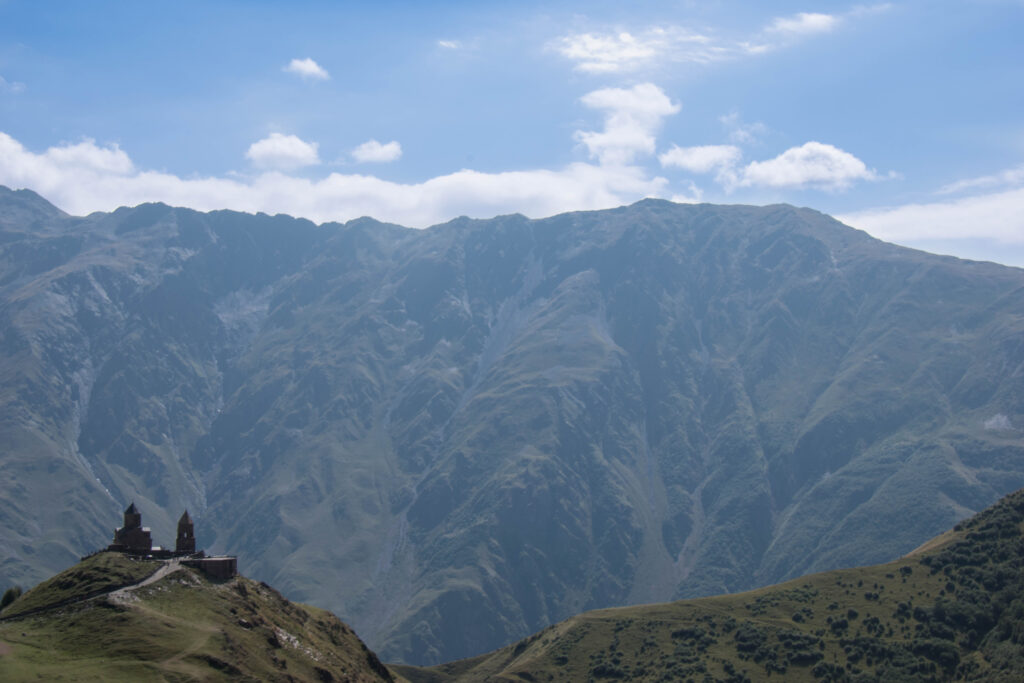
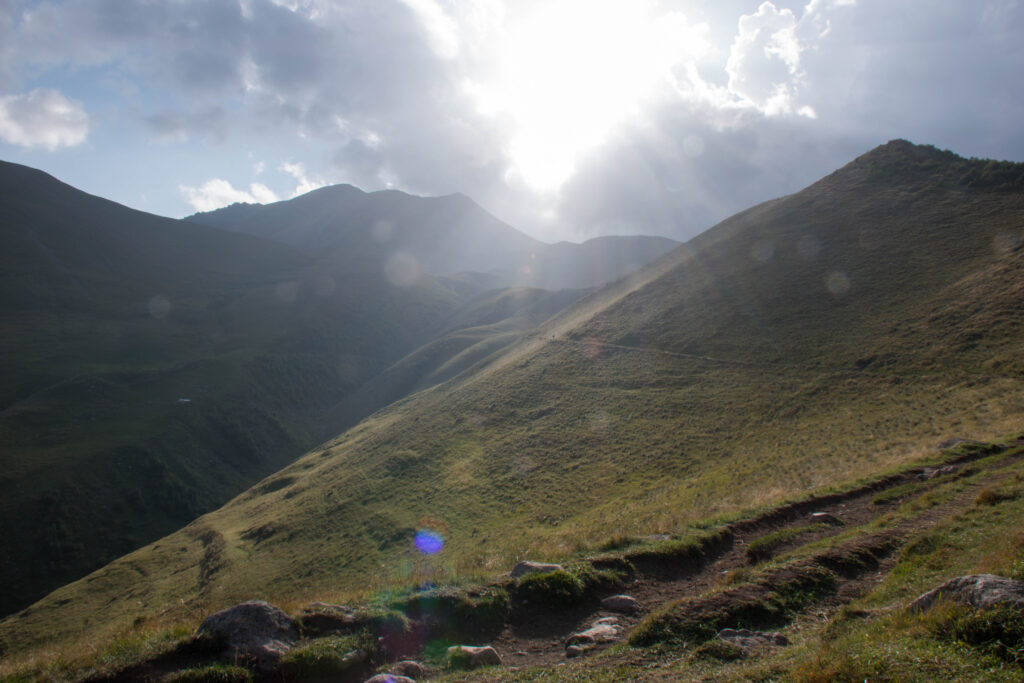
At the foot of the glacier itself, at around 3,280 meters, the urge to keep going runs up against caution: on one side, sandy ground riddled with hidden crevasses; on the other, glacier ice covered with a thin layer of earth that makes it treacherous. Most hikers stop here for lack of crampons — I don’t have any either. I’d rather get home in one piece than tempt fate, so I eat something and head back down. A few drops of rain on the way, nothing dramatic. Back in the village after a 20 km round trip and more than 1,500 m of total elevation gain, a well-earned beer to warm up — it was cold up there.
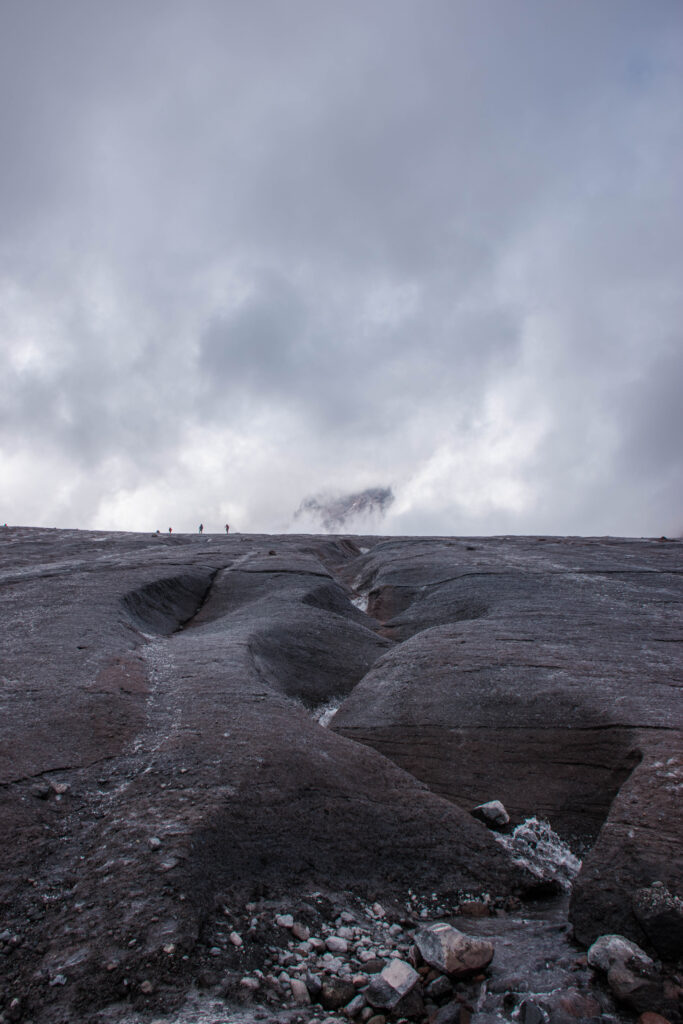
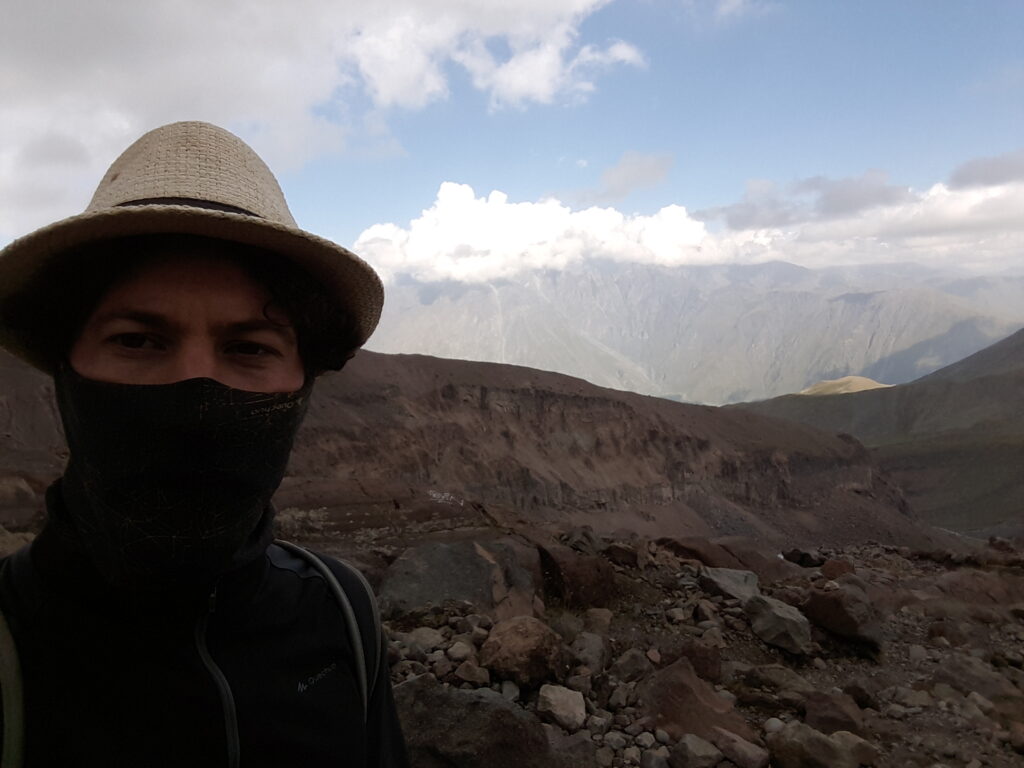
Dust-covered brown ice of the Gergeti glacier at the foot of Mount Kazbek
Hiker in a hat at the foot of Mount Kazbek, Kazbegi mountains behind
Glacial waterfall and meltwater streams below the Mount Kazbek glacier

The glacier is brown because of dust sediment

Back at the hostel, I buy a bottle of red and some cheese to go with the bread and sausage I have left. I offer some wine to a girl sitting across from me — the start of a conversation that quickly spreads to everyone: Daria, a Spanish blogger who’s quite into Instagram, and Rafal, a Polish guy traveling by motorbike, who joins us along the way. The evening goes on with a few of us. As I’m heading to bed, I hear one of the girls in the group swear in French as she walks past me; I wish her good night, and she looks at me, baffled, asking how I guessed she spoke French (Belgian, actually). “I heard a little ‘bordel, putain’…” Cue fits of laughter before bed.

Day 4

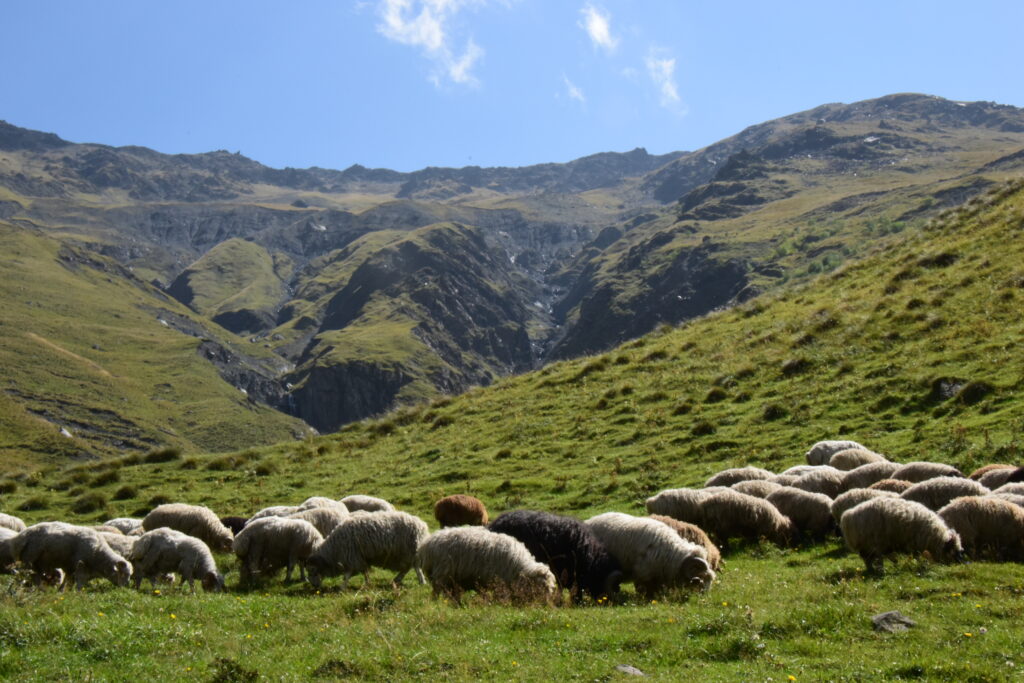
A shepherd for company, the mountains for scenery

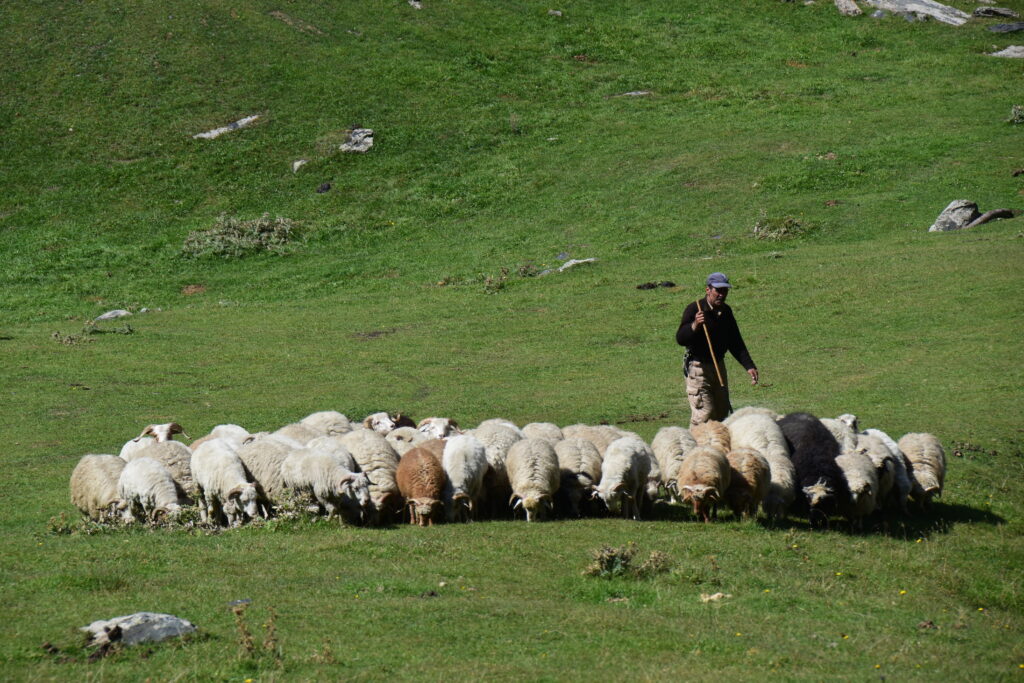
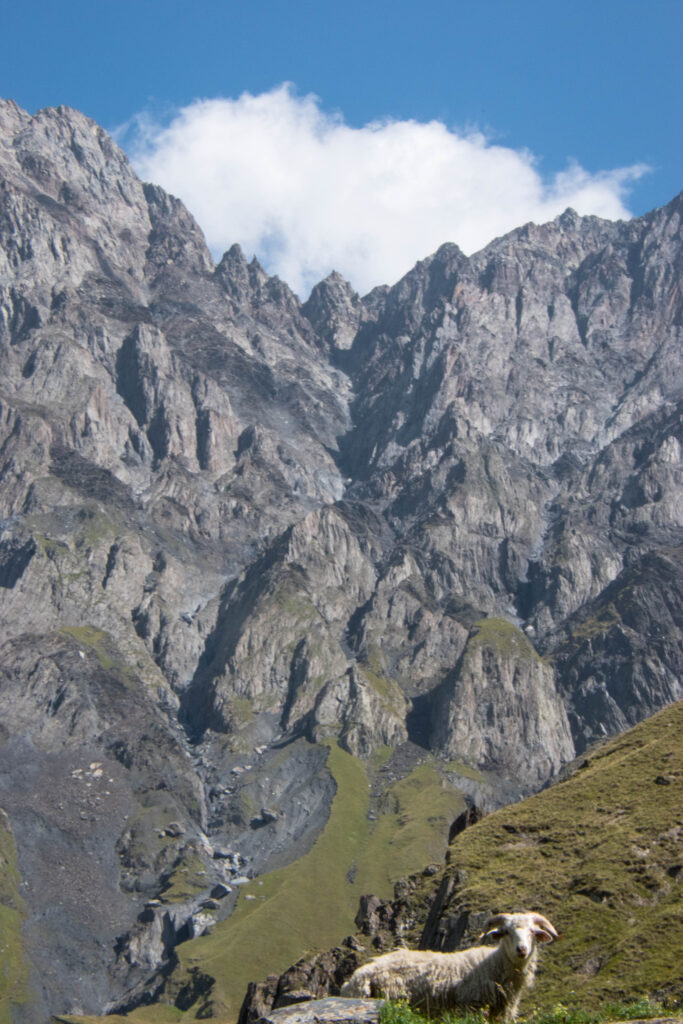
Breakfast with Daria and Rafal, both setting off on the same trek I did the day before — she’ll stop at the church, he’ll try to push farther, maybe even sleep at the weather station, but the cold will decide otherwise. I head off on my own to explore the other side of the valley: two hours of walking with no particular goal, just the pleasure of settling into the grass and watching the mountains. A shepherd comes to sit next to me; I offer him a cigarette, and we talk as best we can, with gestures and scraps of words. After soaking up plenty of sun, I head down through the forest, taking photos along the way, back to the village where I was hoping for an Irish coffee — not available, oh well.

Jagged rocky peaks of the Caucasus above Stepantsminda, Georgia
Flock of sheep grazing on a green slope in the Kazbegi mountains
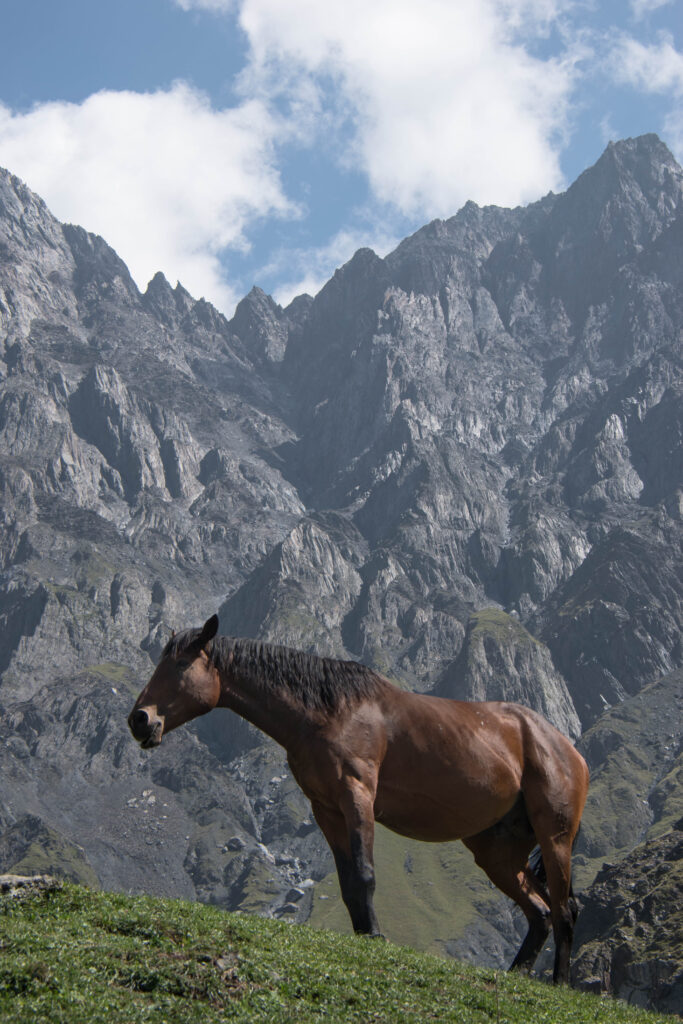
Brown horse grazing in front of rocky Caucasus cliffs near Stepantsminda
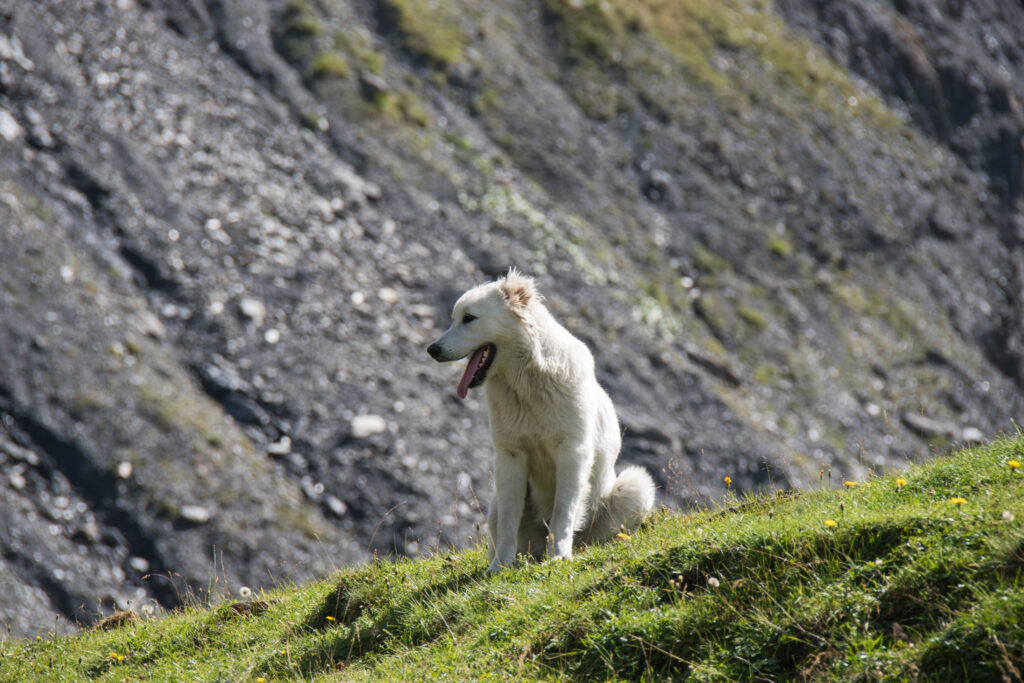
White Caucasian shepherd dog on a grassy slope in the Kazbegi mountains
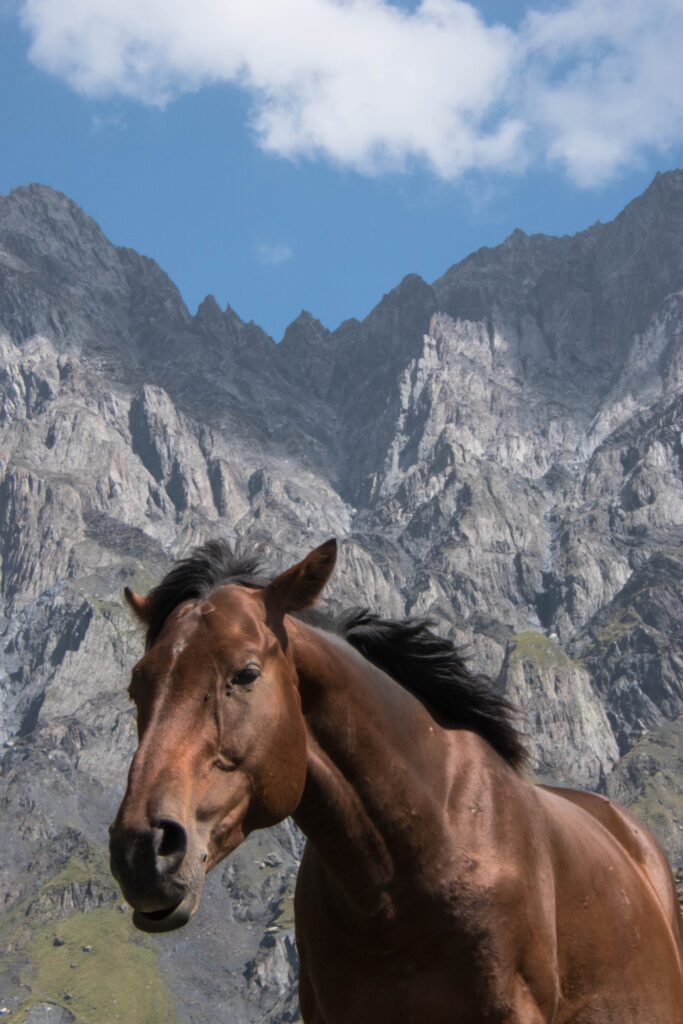
Close-up of a horse with the rocky Caucasus peaks behind
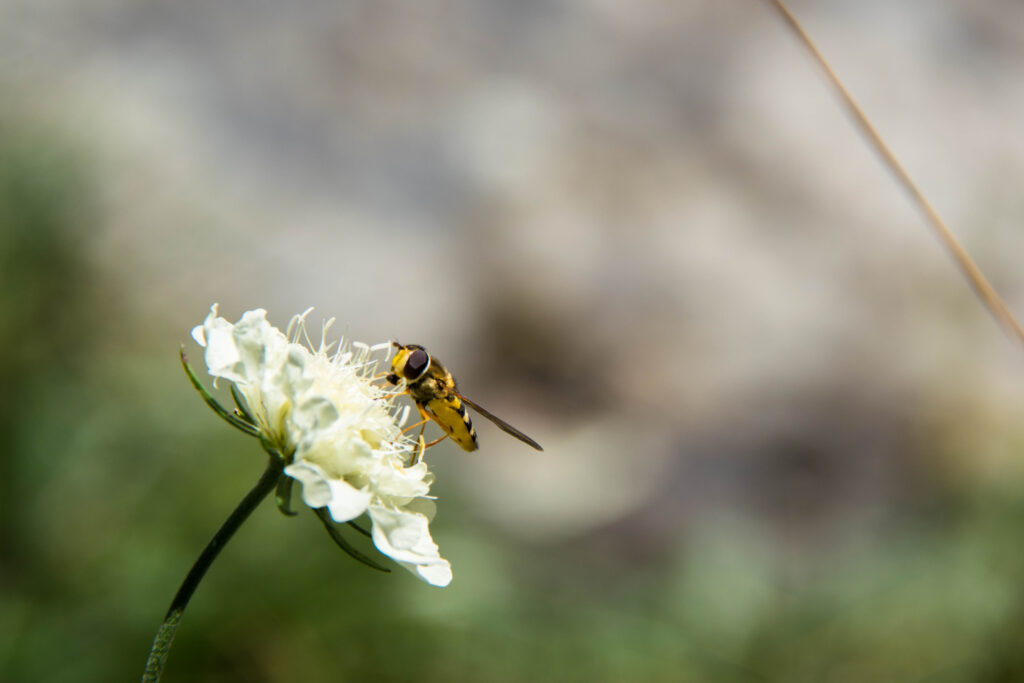
Hoverfly on a white wildflower in a mountain meadow, Kazbegi region
Georgian shepherd with his flock of sheep on a mountain pasture near Stepantsminda

Back at the hostel, I run into the Belgian girl again, who explains she’s traveling around the world without ever taking a plane — a year and a half on the road already, and she still hasn’t left Eastern Europe and Turkey. She’s changing hostels, since there’s no room here; Rafal too. The WhatsApp system keeps up its comic effect: every new arrival has to be briefed on the famous number to call, the info passed by word of mouth between travelers passing through. Daria, Rafal and I end up buying vegetables and wine to cook together at the hostel.

The evening stretches on over travel stories, punctuated by a quick run to a small shop for a bottle of homemade wine. Rafal leaves around 10 p.m. to drop his things at his new hostel, then comes back to finish the evening with us. Really nice.

Panoramic view of Stepantsminda, Gergeti Trinity Church and Mount Kazbek
View of Stepantsminda, Trinity Church and Mount Kazbek
Day 5

Back to Tbilisi and a chacha night at Fabrika

Breakfast with Rafal — porridge, fruit, Turkish coffee — before leaving for Tbilisi. Daria and I take the marshrutka (packed as always), while Rafal rides off on his motorbike with a detour through the Truso Valley, heading for the same hostel I’d stayed in when I arrived. Reunion over a meal. Daria then drags us to Fabrika, a huge hostel tucked away in the middle of nowhere, built around an inner street lined with bars — Rafal compares it to Bangkok’s Khao San Road.

One beer later, off to Bar Warszawa, a Polish bar on Pushkin Street where the beer turns out to be frankly bad, but where Daria insists we try the Chachachello, the house specialty — a shot of chacha (the local grape brandy) with lemon, a bit like a Georgian take on limoncello, sweet but dangerously effective. Everyone buys a round; the beer stays undrinkable, the Chachachello a little less so. As we leave, our attempt to order a local Uber fails — but three young Georgians walking by, seeing us struggle, call a driver for us themselves. He ends up canceling without explanation; never mind, they hail a taxi, pay for the ride themselves (barely 5 lari) and bundle us in, without us asking for anything. Back to the hostel, lights out.

Day 6

A quiet day between a roller coaster and a wine bar

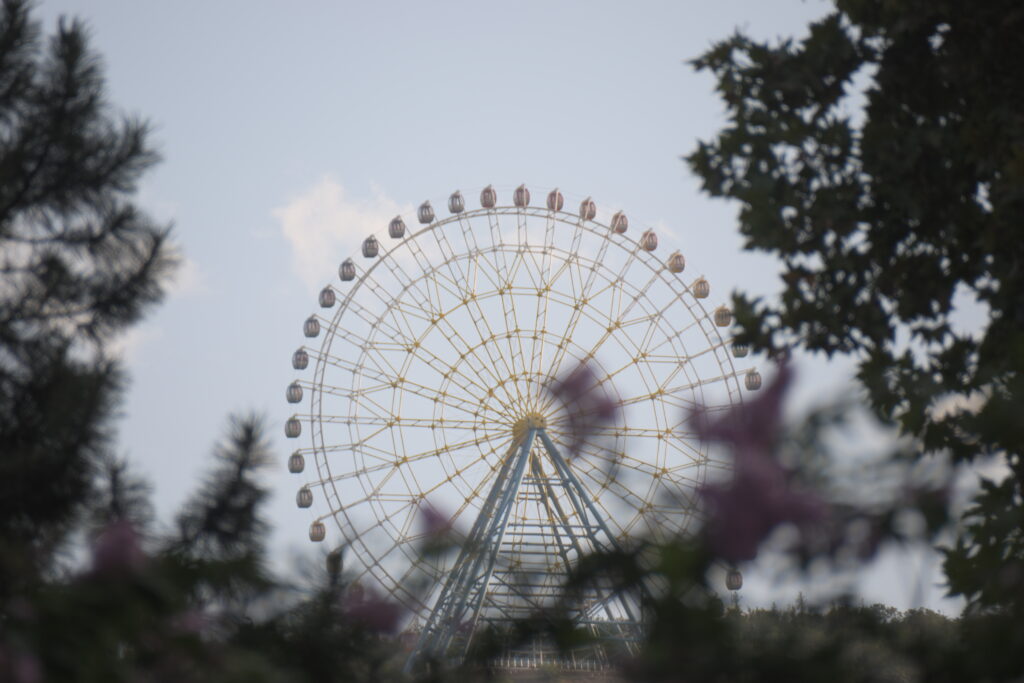
Up before the other two, whose heads are a bit heavy after last night. I go down for breakfast, then keep them company with a drink while they order food. Daria and Rafal are both leaving for Yerevan today — goodbyes, and a bit of time at the hostel before heading out to explore Mtatsminda amusement park, perched on the hill overlooking the city. I walk halfway up before laziness wins and I take the funicular the rest of the way. Nothing extraordinary once at the top, but the atmosphere is relaxed: a drink break next to the roller coaster, then back down to town on foot. On the way, a stop at a wine bar where I chat with the waitress, who’s planning a trip to Strasbourg — small world. Back to the hostel in a light rain. An uneventful day, but a pleasant one.

Ferris wheel at Mtatsminda amusement park on the hill above Tbilisi
Mtatsminda amusement park
Day 7

Old town, modern bridges and a khinkali lesson

A disrupted night thanks to a traveler I hadn’t even heard come in, who leaps out of bed to throw up over the balcony (maybe he went a little too hard on the chacha 😂) — this hostel gets a little stranger every day. Check-out that same morning for a real hotel, with a real room and somewhere to catch my breath — spa, pool — after a whole week sleeping in dorms and racking up kilometers on foot. Two last days planned here, to recover before heading home.

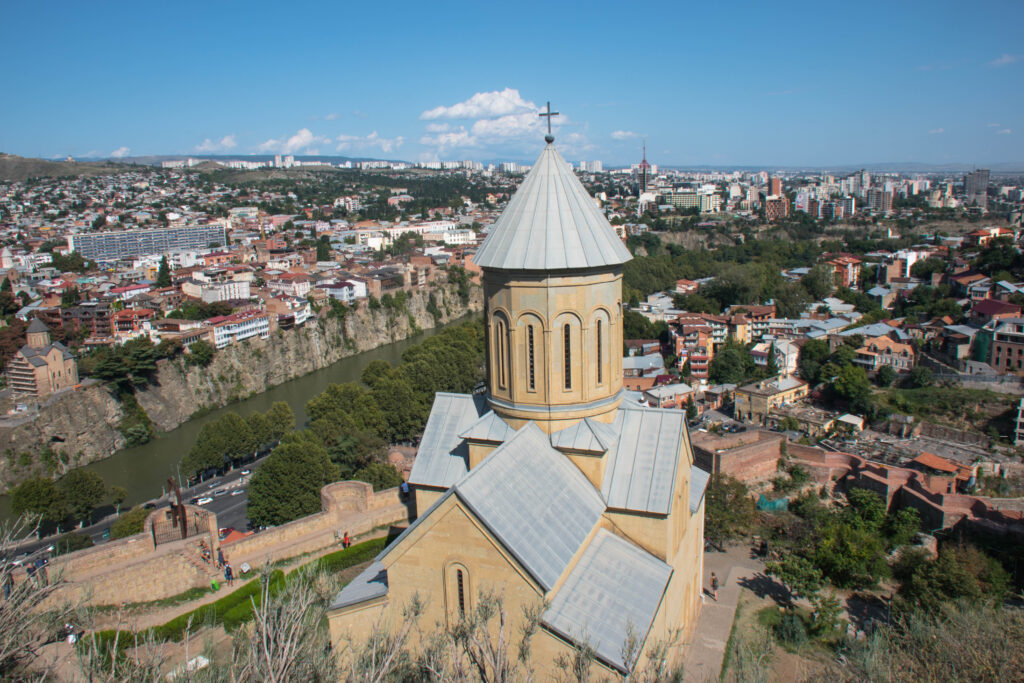
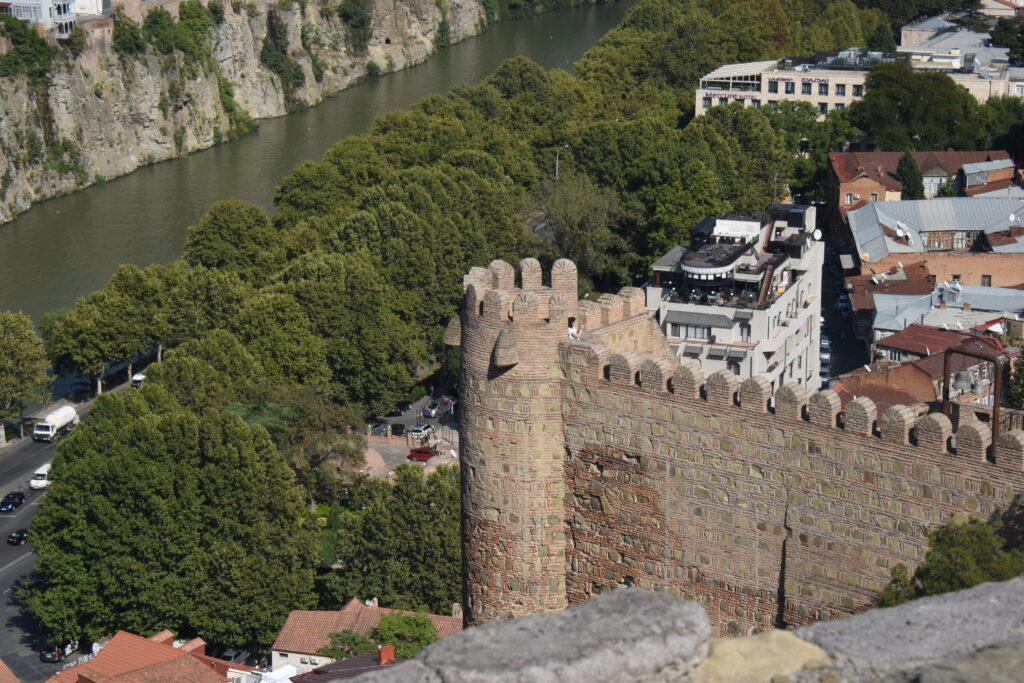
Next, off to Narikala Fortress, an old stronghold half abandoned, but whose charm works all the same.

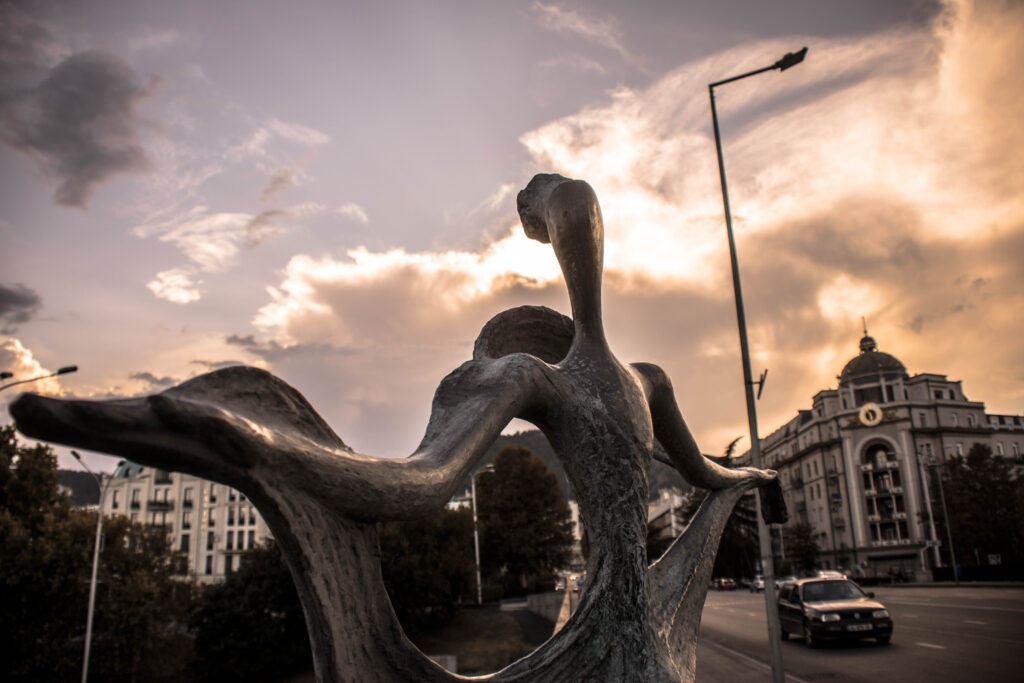
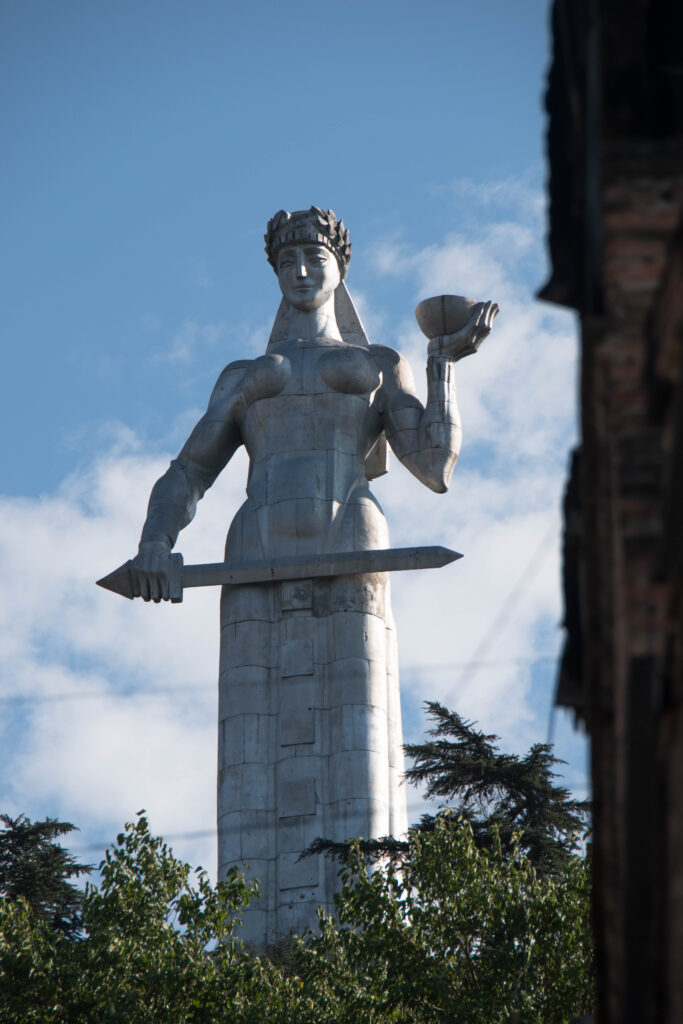
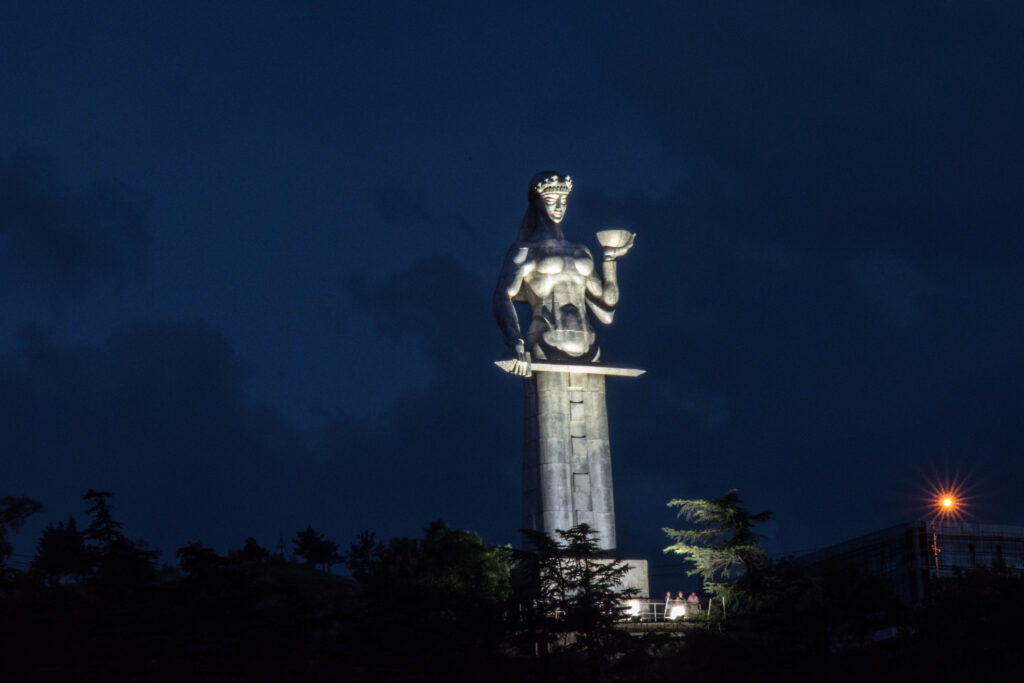
Right next to it stands the statue of Mother of Georgia (Kartlis Deda) — twenty meters of aluminum, a cup of wine in one hand and a sword in the other, symbolizing both the country’s hospitality and its ability to defend itself.

Mother of Georgia (Kartlis Deda) statue holding a sword and a cup of wine, Tbilisi
Mother of Georgia statue lit up at night above Tbilisi

Mother of Georgia

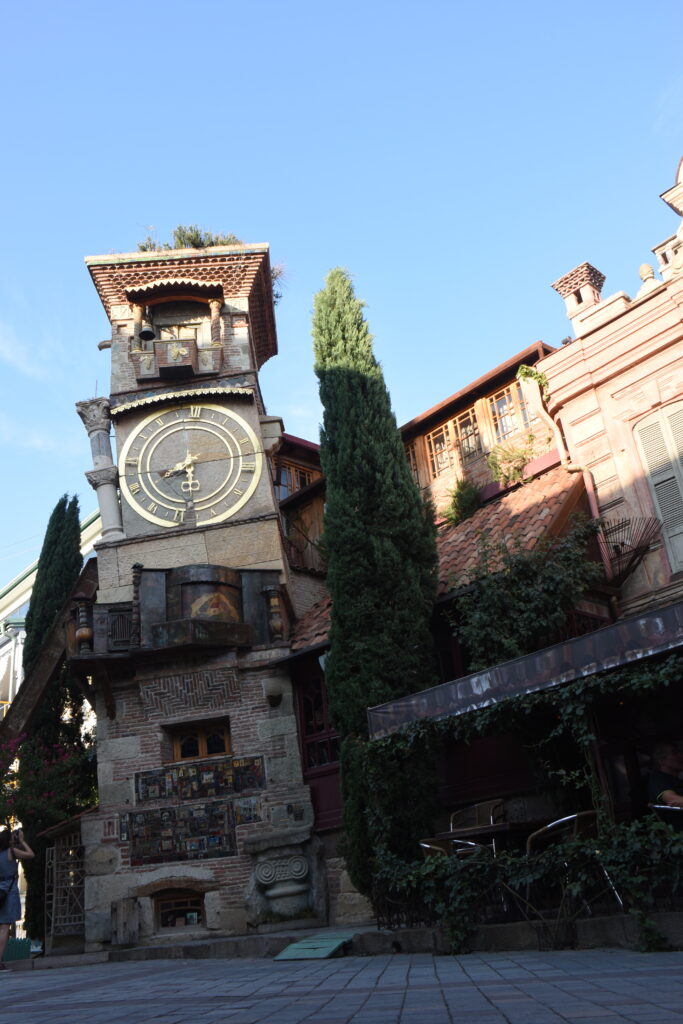
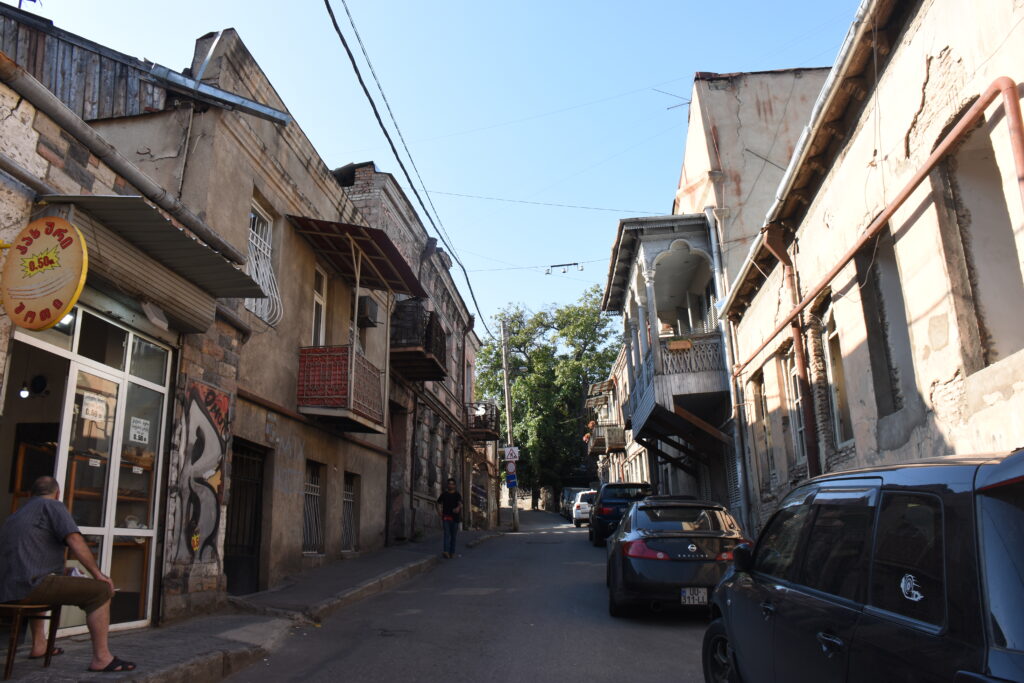
On the way down, I get lost on purpose in the lanes of the old town and stumble upon the Gabriadze Clock Tower, a slightly whimsical leaning tower with its automatons — nice, and the restaurants around it are surprisingly expensive for the country (the old town is a bit more touristy).

Narrow street with old balconied houses in Tbilisi old town
Old town street

Then on to the Baratashvili Bridge, right next to the Clock Tower — nicknamed the “Bridge of Love,” known for the bronze statues of embracing couples that decorate its railings,

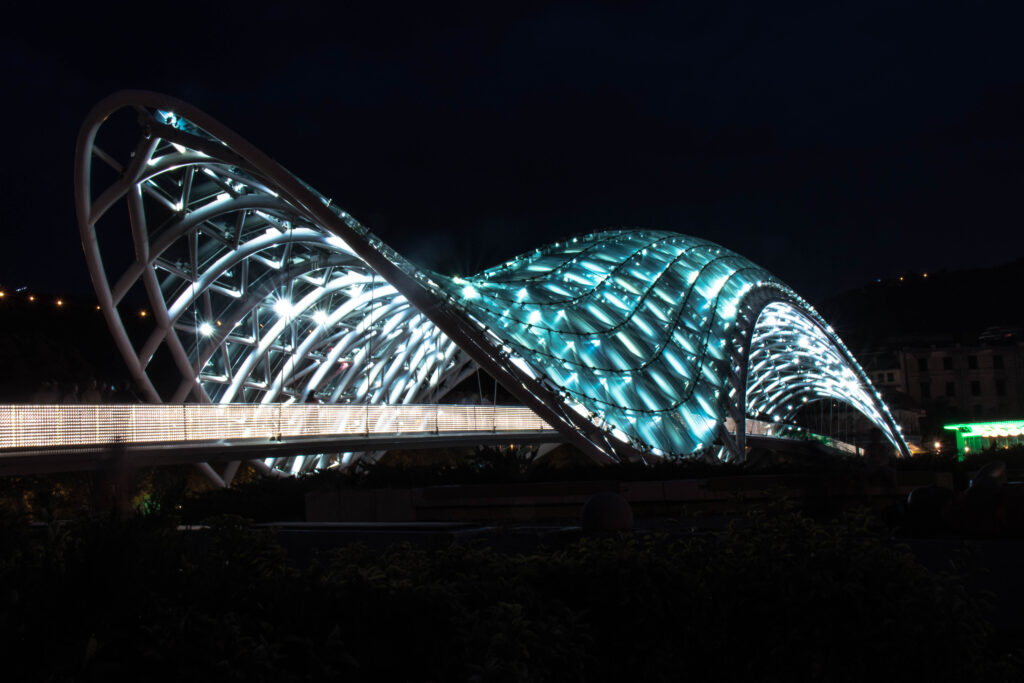
Then the Bridge of Peace, a modern pedestrian bridge where I take a photo break in the adjacent park.

On the way back, I stop at a small, unpretentious restaurant. Seeing me step out for a cigarette, the owner calls out “take more wine and go” and ends up joining me outside to chat — an Armenian who lived in Toronto for a long time. Back at the table for my khinkali (huge Georgian dumplings), the old lady serving me rushes over to show me how to eat them properly, cracking up at the sight of me improvising. She does the same routine with the next dish, a khachapuri — a sort of bread stuffed with egg and cheese. A real stand-in mom for the length of a meal. I end the evening making friends with a Siberian, who proudly shows me his photos taken at Fabrika, before heading back to the hotel.

Day 8

A last wander through the old town, and a farewell below the cathedral

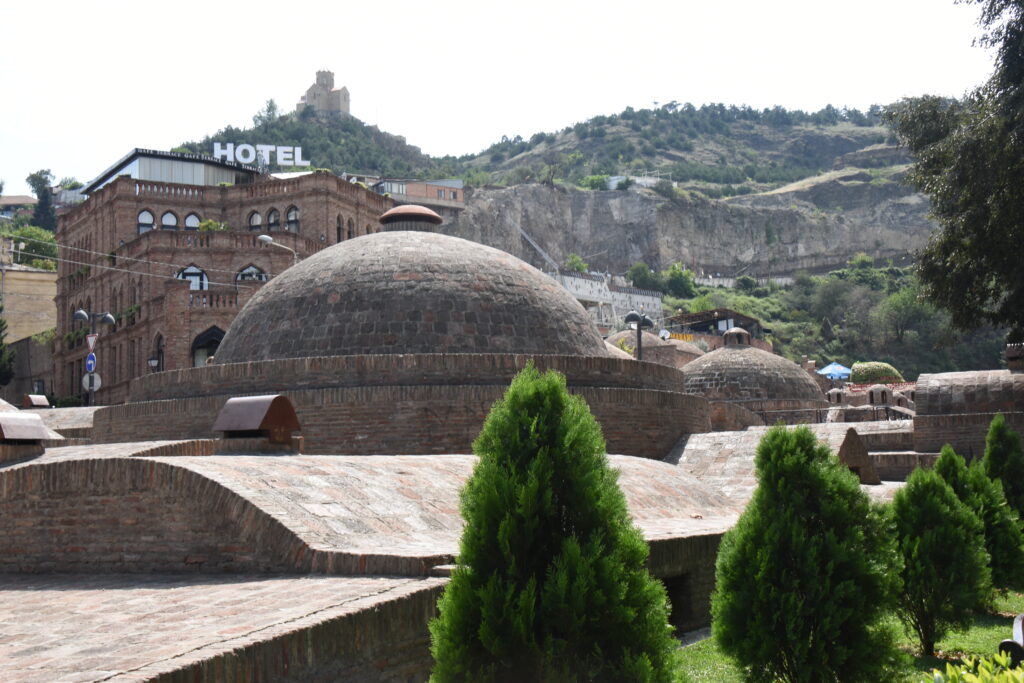
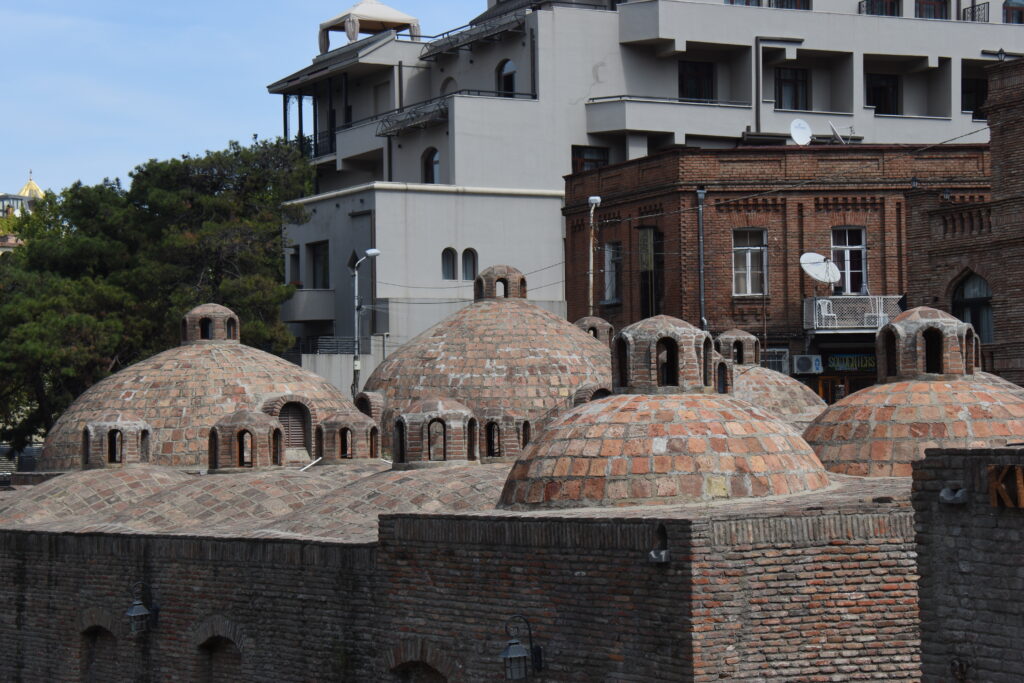
For this last day, back to wander the old town — heading for the Abanotubani district, known for its sulfur baths whose brick domes push up out of the ground like beehives, a very particular architecture unlike anything else in the city.

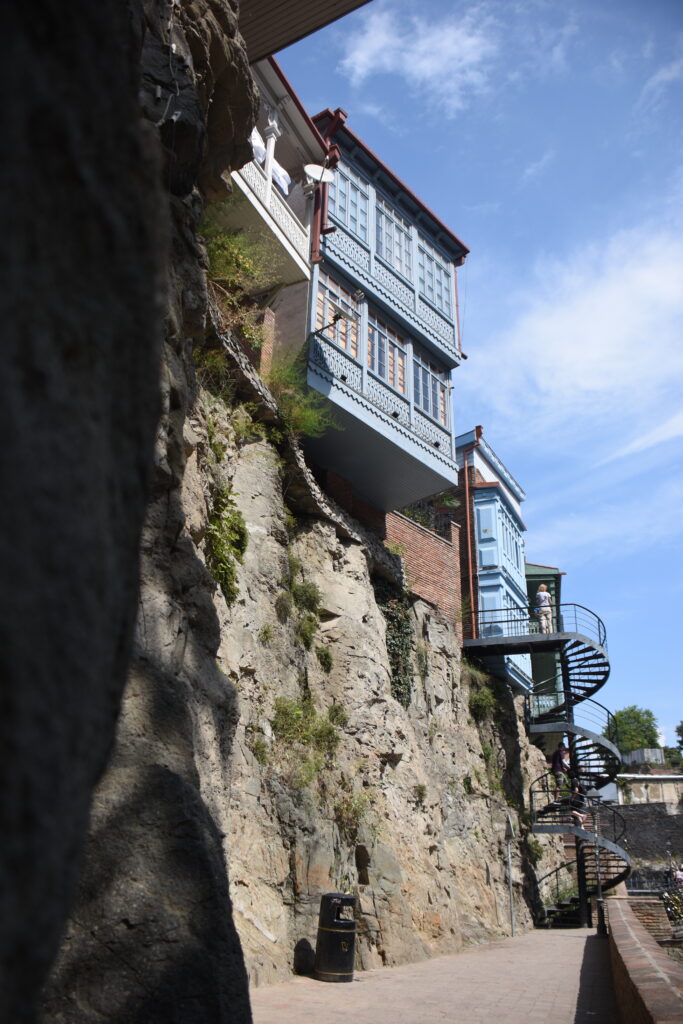
I continue on foot through the Leghvtakhevi canyon to the waterfall of the same name. All along the way, old wooden houses literally cling to the rock face, balconies jutting out over the void and a spiral staircase winding between the homes — one of the most unusual corners of the old town.

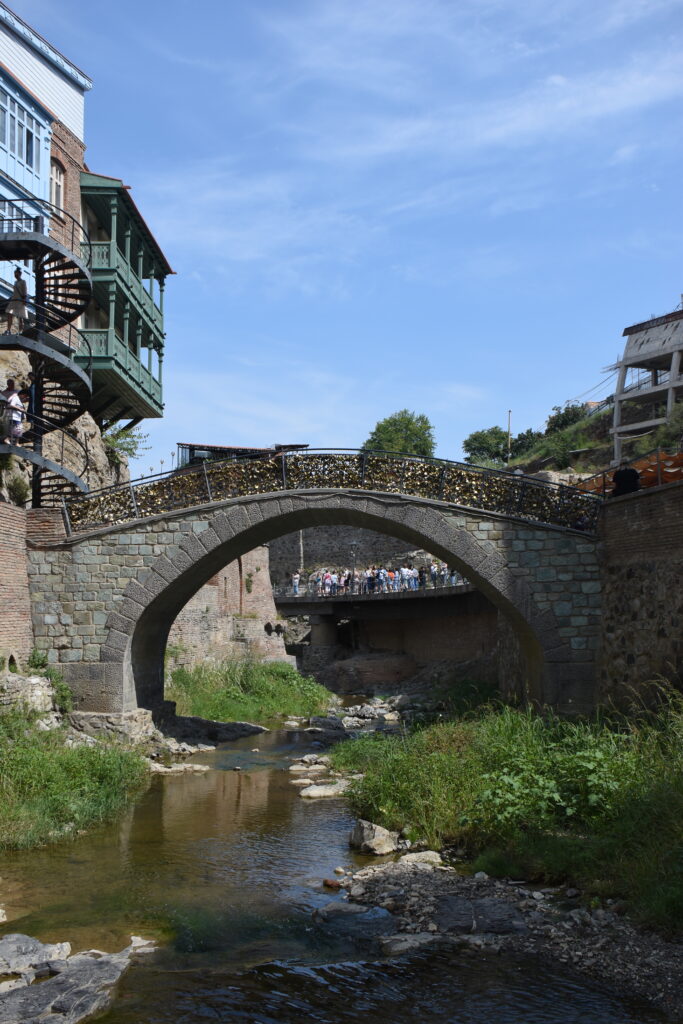
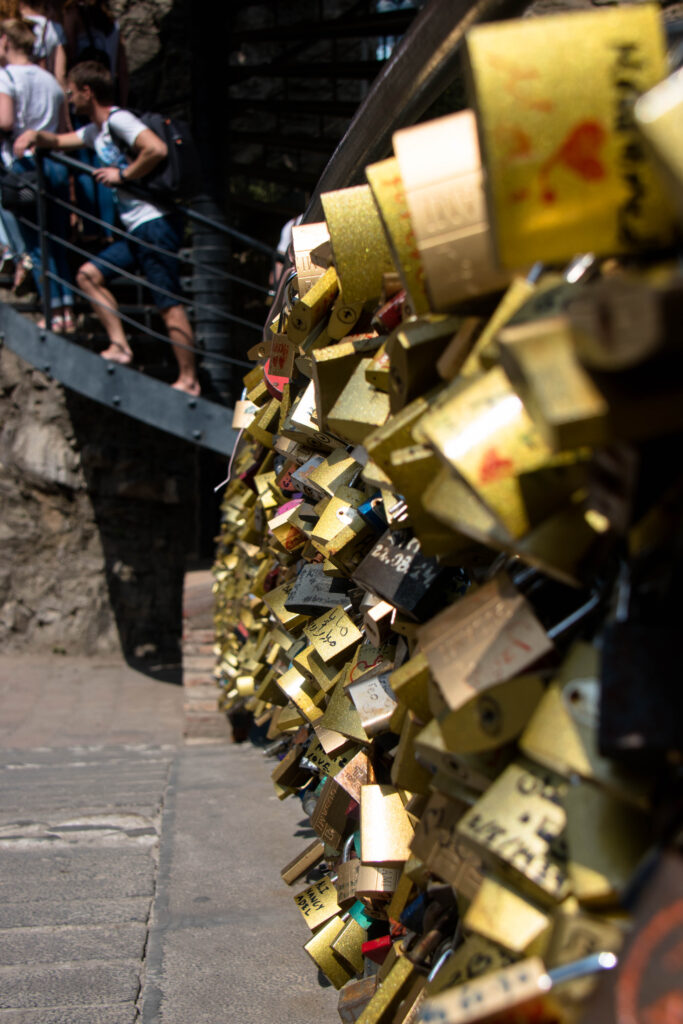
Along the way, a second “Bridge of Love,” different from the one the day before: a small footbridge covered in hundreds of padlocks meant to seal couples together forever, in the same spirit as the Pont des Arts in Paris before all its locks were removed.

I linger until nightfall to see the canyon lit up — the place takes on a completely different atmosphere once illuminated.

Leghvtakhevi canyon lit up green at night, Tbilisi
Leghvtakhevi canyon at night

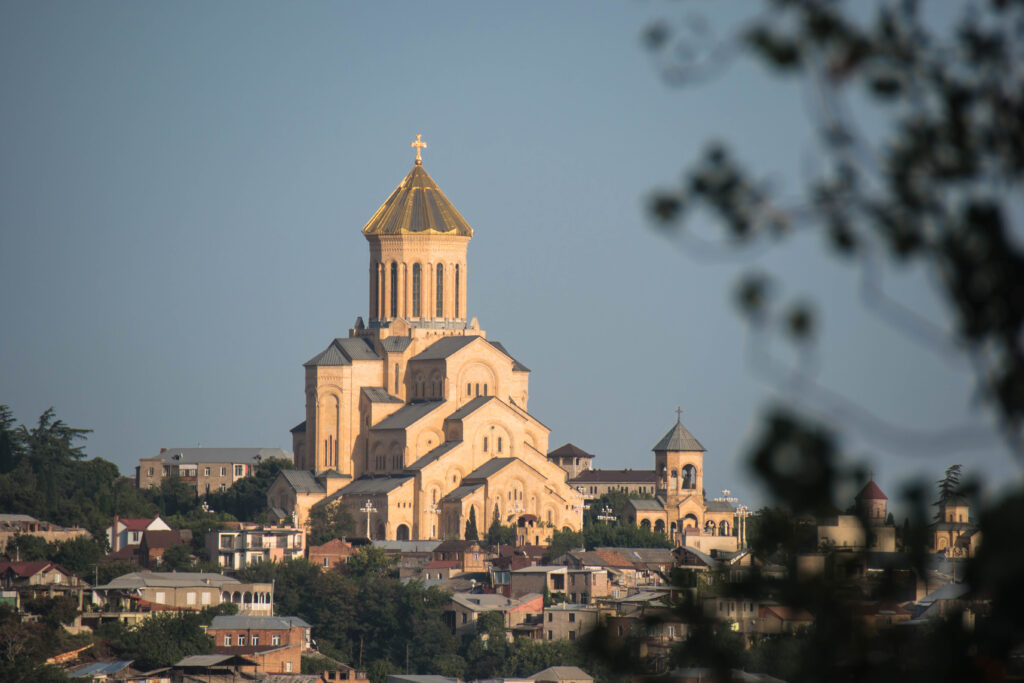
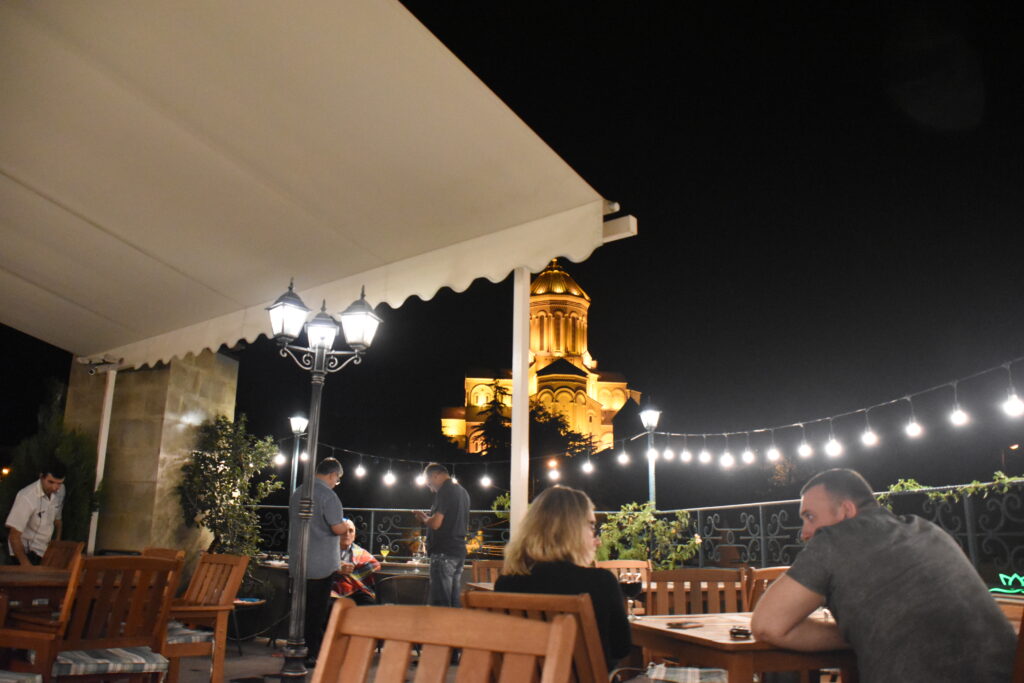
Then on to Holy Trinity Cathedral (Sameba), the largest Orthodox church in the country, for a last dinner with a view of the illuminated building — and the surprise of a small impromptu concert of Georgian music in the restaurant. A lovely way to end the trip.

Looking Back

A week that will mostly be remembered for a string of improvised, generous encounters: people met by chance one evening over a bottle of wine and found again several days running, all the way to Tbilisi; three strangers paying for a taxi without anyone asking them to; an old lady more attentive than any tour guide, teaching you how to eat a khinkali. Between the peaks of the Caucasus and the lanes of Tbilisi, Georgia is remembered less for its monuments than for the almost systematic generosity of the people you meet along the way.

5:30 am, and the valley has vanished. In its place, a river of clouds flows between the mountains, and the sun rises just above the ridges. This is the moment people come to Ta Xua for, a village perched in the mountains of northwest Vietnam. We spent three nights there as a couple in August 2025, right in the rainy season, so outside the official cloud season, and we still got our sea of clouds. Here’s what you really see at that time of year, how to walk the Dinosaur Spine (on foot, not by scooter), which mountain roads to ride on two wheels, and how to get there from Hanoi without getting stuck in Bac Yen.


Where is Ta Xua, and is it worth visiting?

Ta Xua (Tà Xùa in Vietnamese) is a mountain village in Son La province, in northwest Vietnam. People come for three things: the clouds that fill the valleys at dawn, grassy ridges like the Dinosaur Spine, and the small mountain roads, where every bend opens up a new view.

You won’t see many Westerners here. During our stay, we may well have been the only Western tourists. It was still busy, though, mostly with young Vietnamese people up from the city as couples or groups of friends, often dressed up and there largely for the photos.

The village is changing fast: in August 2025, there was construction work going on almost everywhere. Ta Xua is likely to become much more touristy in the years to come.

Who is it for? If you love nature, photography and mountain roads on a scooter, and you’re ready to get up before 5:30 am to see the clouds, Ta Xua is well worth the trip.

Who might struggle? If you’re looking for guided tours in English, lots of services or an international backpacker vibe, you’ll feel less at ease: English is rare, and communicating takes a bit of patience.


The sea of clouds: when to see it, and what you see in August

Cloud season

According to local sources, the best time to see the sea of clouds in Ta Xua runs from October-November to April, peaking from December to March. Summer is the rainy season: the sources advise against it, mainly because the tracks get slippery and landslides can happen.

What we saw in August 2025

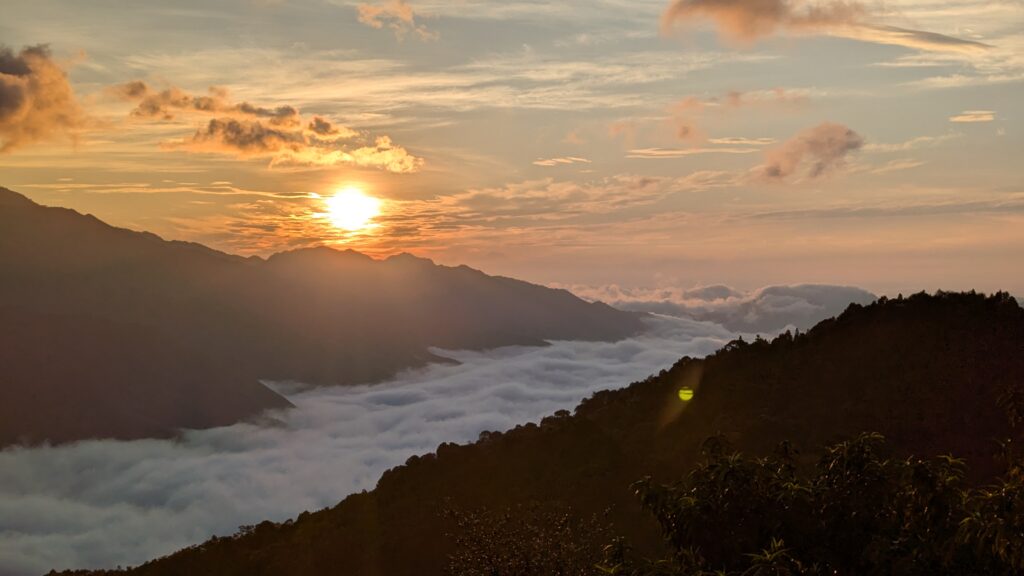
On 20 August, around 5:30 am, from the terrace of our guesthouse: a real sea of clouds, filling the valley under an orange sunrise. Probably lower and less spectacular than in peak season, but the show was definitely there.

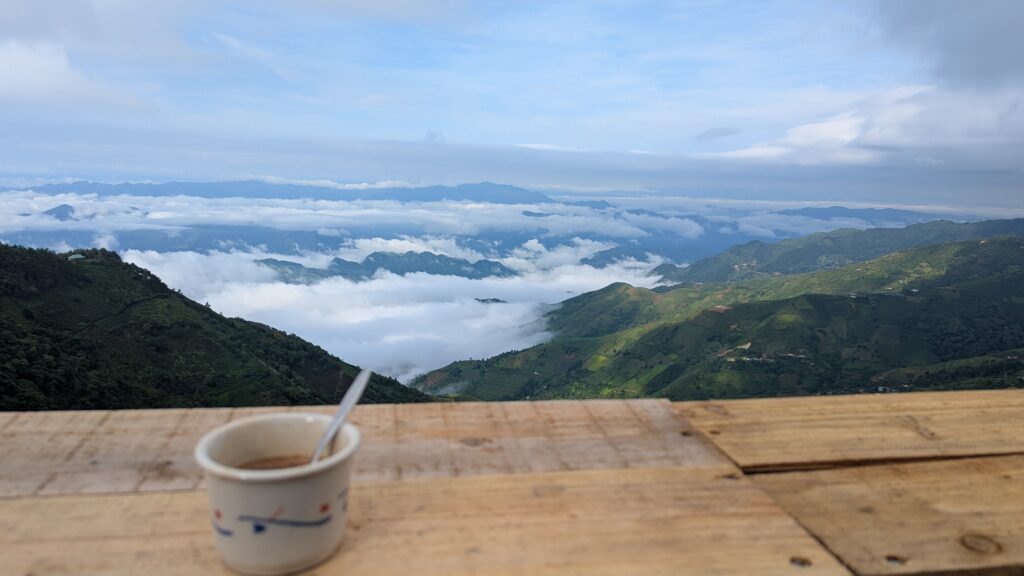
The same day around 8 am, from a small café-bar north of the village, facing east: it wasn’t quite a sea of clouds anymore, but there were still beautiful banks of cloud in the valley, with the sun on the hills.

The other mornings, a little later: just a few clouds, not really a sea.

Our verdict: in August, the sea of clouds is possible, not guaranteed. One good morning out of three for us. The weather on the day decides, and nobody can promise it to you.

How to give yourself the best chance

  • Stay somewhere with a valley view: we saw the sea of clouds from our terrace, without having to ride a scooter in the dark.
  • Stay several nights: with just one night, we might have missed it.
  • Get up early: the show happens at sunrise, around 5:30 am in August.
  • If the clouds clear, don’t leave right away: a café facing east, early in the morning, still gives you a great view of the clouds lingering in the valleys.

The Dinosaur Spine: access, time and difficulty

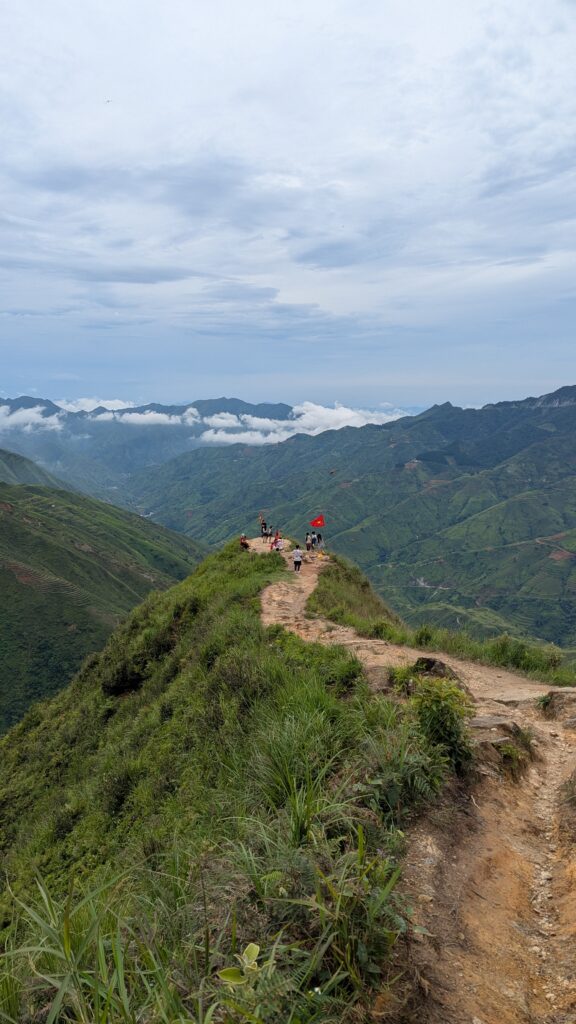
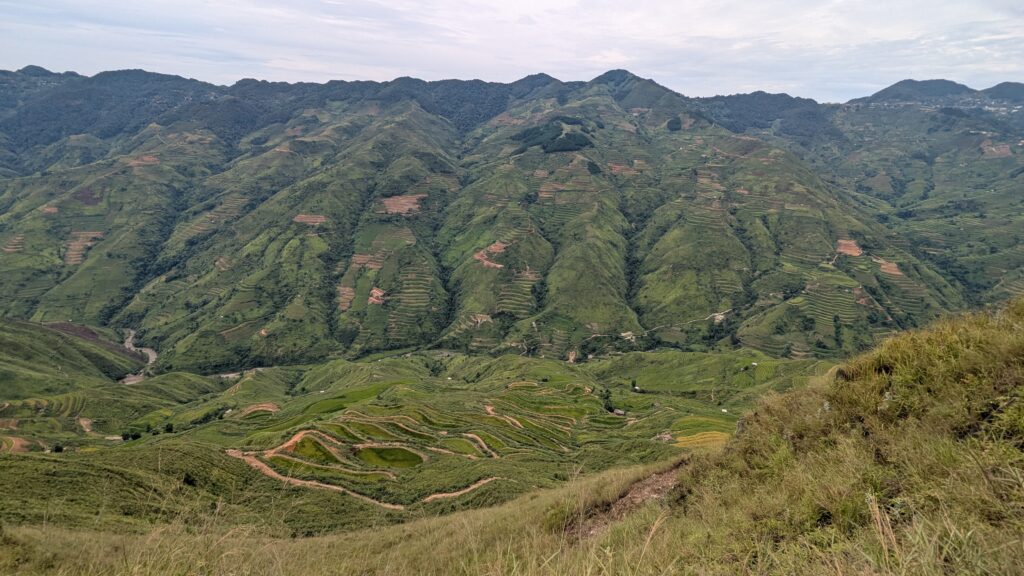
The Dinosaur Spine (Sống Lưng Khủng Long, also called the Dinosaur Ridge) is Ta Xua’s signature hike: a narrow grassy ridge with steep slopes on both sides, looking out over the mountains and terraced rice fields. According to the sources, the ridge is about 0.6 miles (1 km) long and sits between about 4,900 and 5,900 feet (1,500 to 1,800 m) above sea level.

Getting to the trailhead

We rode there by scooter from the village. You park in a paid parking area just before the start of the trail: about 10,000 VND (less than half a dollar) for a scooter in August 2025, if I remember right. From there, you have two options: carry on on foot, or get a ride down on a motorbike with a local rider (see below). We did the whole thing on foot, and it’s absolutely doable.

How long does it take?

Allow about 1 hour to walk down to the end of the ridge, and 1 hour or a bit more to climb back up. The way back up is the most tiring part: save some energy (and some water) for it.

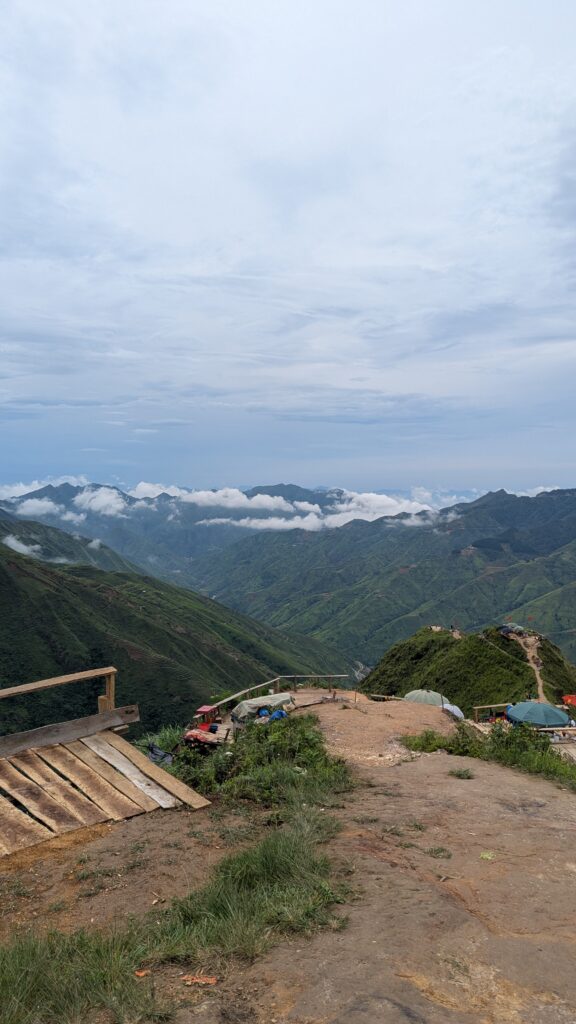
Along the way, one of the first viewpoints is a small open area with stalls, tents and parasols: a good spot for a break before you tackle the ridge.

Should you ride the Dinosaur Spine on a motorbike?

No, and I strongly advise against it. Some people take their scooters onto the trail, and some tour companies sell the Dinosaur Spine as a motorbike ride. But the path is genuinely dangerous on two wheels: slippery, and full of holes dug by the rain when we were there. On foot, it’s a pleasant walk and you get to enjoy the view. On a scooter, it’s a gamble.

If you don’t want to walk, local young people ride up and down the spine on motorbikes, taking visitors (mostly Vietnamese) down and back up. We sometimes saw them carrying two or three passengers on the same seat. It’s doable, and they know the path, but I don’t recommend it: it’s still dangerous. I don’t know the price, as we didn’t ask. And if you’re not an experienced off-road rider, don’t try this track on your rental scooter.

At the end of the ridge, look for the little side path

The end of the ridge was busy. We took a small path off to the side, which leads to a quieter spot where we were on our own. Two young girls in traditional dress joined us there, without trying to sell us anything: they tried to chat with us, then gave us some little flowers. A lovely memory, and proof that not every encounter is about money.

On the trail itself, though, you’ll pass locals in traditional dress selling flowers, mostly to Vietnamese visitors who use them in their photos.

Before you go: bring water, sun protection and shoes with good grip, as the trail can be slippery after rain.


Mountain roads by motorbike: the viewpoints around Ta Xua

The other joy of Ta Xua is riding the small mountain roads and stopping whenever the view opens up. Here’s what we did in two days on a scooter.

A word of warning first: neither Google Maps nor Maps.me is reliable here. Many viewpoints have no name on the maps, or several names, and some roads have no name at all. The names below are the ones we found, so take them with a pinch of salt.

Dolphin Cliff (Mỏm Cá Heo)

A big rock jutting out over the valley, with a wide-open view of the mountains.

The Lonely Tree (Cây cô đơn)

We rode past without stopping. To get close to the tree, there was an entrance fee, if I remember right. Honestly, it didn’t seem that interesting to us: it’s mostly a photo spot. But if you want the iconic Ta Xua photo, that’s where to go: bring a little cash for the entrance.

Camel’s Back

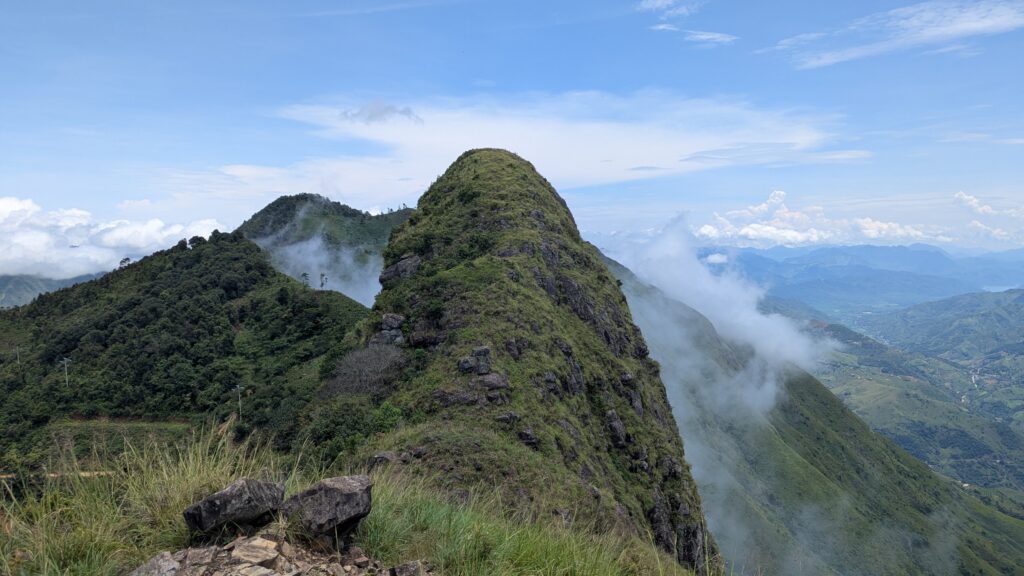
We stopped at a viewpoint that we believe is the Camel’s Back: a small grassy, rocky hill, with clouds creeping up its sides that day.

There’s no sign. We parked in what looked like a parking area, then looked for the path up to the top of the hill. The climb is neither long nor hard, but it isn’t a flat path, and it can be slippery: wear shoes with good grip.

Grassy hill of the Camel's Back with clouds, near Ta Xua, Vietnam

The road east, down to the river

A road heads east from Ta Xua, with viewpoints we found more or less by chance, stopping as we went round the bends. We followed it to the bank of a river (the Suoi Be on Maps.me, nowhere to be found on Google Maps), then turned back, passing the Háng Đồng A1 hydroelectric plant on the way up.

No famous spot here: just the mountains and the road. If you like routes few visitors take, it’s a beautiful ride.


How to get from Hanoi to Ta Xua (and the Bac Yen trap)

The first thing to know: you’ll almost certainly go through Bac Yen. Big buses don’t go up the small mountain roads to Ta Xua. So the trip is done in two legs, with a change in Bac Yen.

The trap isn’t Bac Yen itself, it’s arriving there with no connection lined up. We tried both: no booking at all on the way there, a trip booked end to end on the way back.

On the way there: what we did

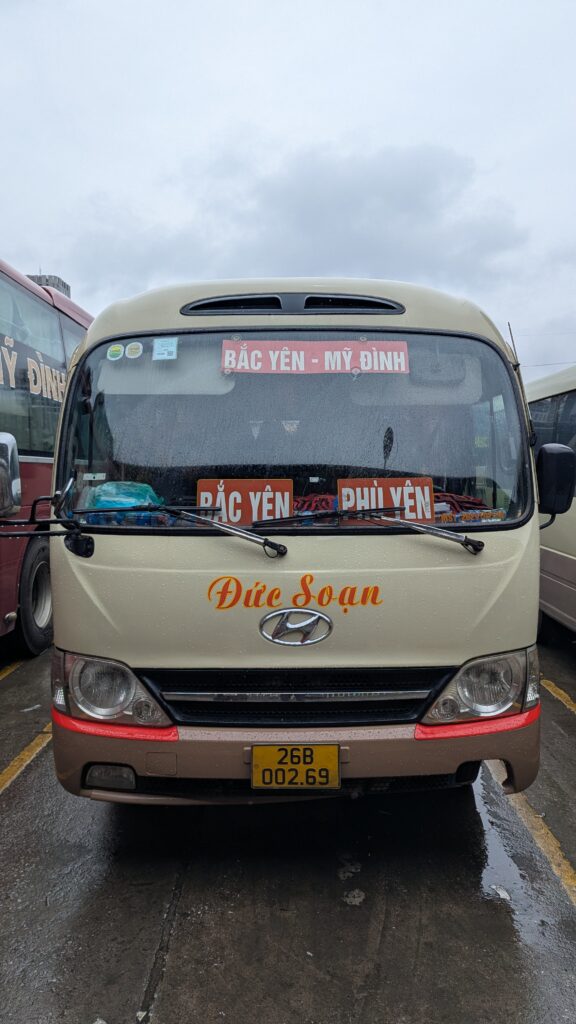
We hadn’t booked anything. We simply went to My Dinh bus station (Bến xe Mỹ Đình), in the west of Hanoi, where we took a local minibus signed “My Dinh – Bac Yen”, thinking we’d find a local bus to Ta Xua from there.

  • Minibus Hanoi → Bac Yen: 400,000 VND for two (about US$15) in August 2025.
  • Then, in Bac Yen, nothing left for Ta Xua. There may be a local bus, but if so, we arrived too late. A taxi was the only option: 400,000 VND (about US$15).
Local minibus from My Dinh bus station to Bac Yen
The local minibus from My Dinh to Bac Yen

My advice: book a complete Hanoi → Ta Xua trip

Looking back, the easiest way is to book an end-to-end trip in advance. Don’t be surprised if there’s still a change in Bac Yen: there was for our return trip (see below). The difference is that the connection is organized and included in the price, with no unexpected taxi.

You have two options for booking:

  • Online, before you leave: Hanoi → Ta Xua and Ta Xua → Hanoi trips show up on booking platforms, with times and prices. We haven’t tried it, but it’s probably the easiest way: no language barrier, and you know what to expect.
  • At a local agency, once you’re there: that’s what we did for the return trip (see below). It works, but be ready for a bit of patience.

If you’d rather do what we did on the way there, by local bus, leave Hanoi early and budget for the taxi from Bac Yen.

On the way back: a booked trip, minibus then sleeper bus

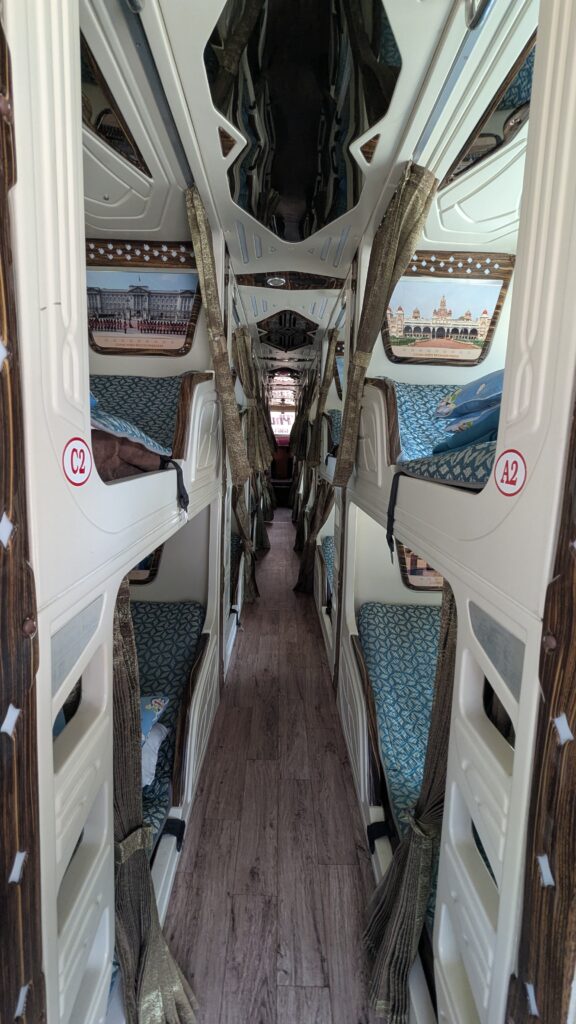
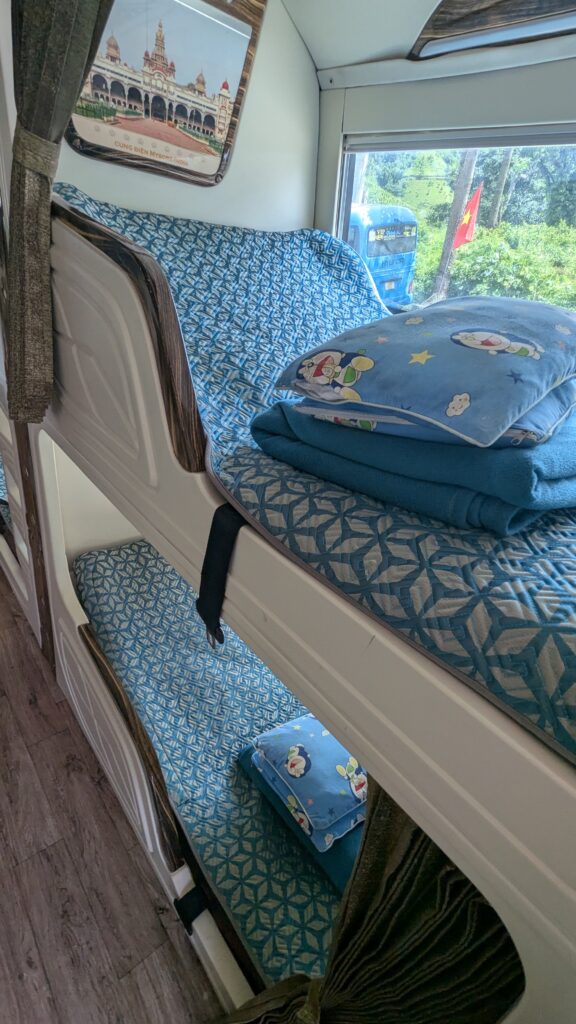
This time, we booked our Ta Xua → Hanoi trip at a local agency in the village. Making ourselves understood wasn’t easy: nobody spoke English, and we were first offered a taxi at a crazy price. In the end, we got the complete trip. In practice, it was a minibus to Bac Yen, then a change to a sleeper bus to Hanoi, all on the same ticket. We traveled by day, with a pillow and blanket provided on the sleeper bus. Price: about 450,000 VND per person (about US$17) in August 2025, if I remember right.

For two people, it’s a bit more expensive than our way there (minibus then taxi, about 800,000 VND for two), but with no bad surprises: you know from the start what you’re paying and how you’ll get there.


Renting a scooter in Ta Xua: license and insurance

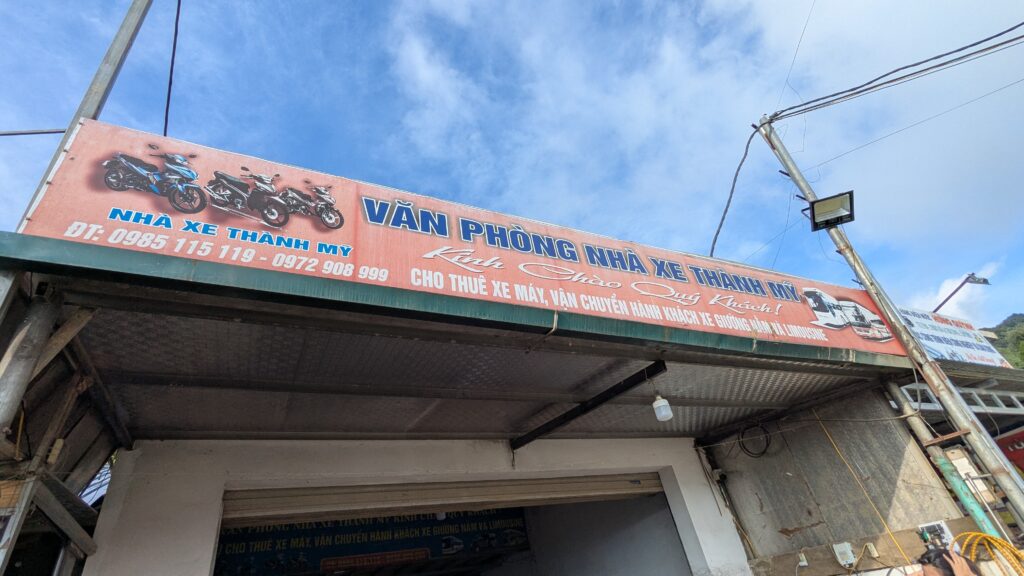
We rented our scooter from Nhà xe Thành Mỹ, in the village: 300,000 VND for two days (about US$11) in August 2025.

Front of the Nhà xe Thành Mỹ shop, where to rent a scooter in Ta Xua

Nobody asked to see a license. But not being checked by the rental shop doesn’t mean you’re legal: to ride a scooter in Vietnam, you need a license valid for motorbikes and an International Driving Permit recognized by Vietnam. Without a valid license, your travel insurance may not cover you if you have an accident. Before you go, check your license and read your insurance policy.


Where to stay in Ta Xua

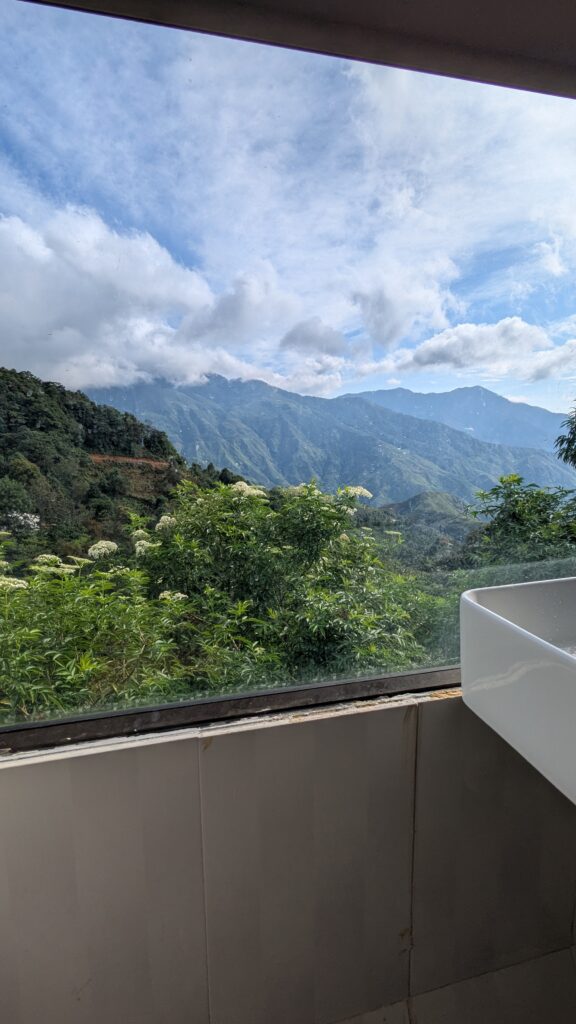
We stayed at Cloud Garden, about €22 (about US$25) a night in August 2025. It was nice, with one real highlight: the terrace, looking out over the valley. That’s where we saw the sea of clouds on 20 August, without leaving our guesthouse. Even the bathroom has a mountain view. The downside: an extremely hard mattress.

Our tip for choosing where to stay: before you look at the price, look at the view. In Ta Xua, a terrace facing the valley means you can enjoy the clouds when you wake up, without riding in the dark.


Where to eat and drink in Ta Xua

No need to look far: in August 2025, you could find food all over the village, for every budget. We don’t have a specific address to give you, and that’s on purpose: we rarely pick a restaurant in advance. We look at the menu, the prices, the food and the setting, and we go wherever is open. In Ta Xua, that works really well.

Menus are very rarely in English: a translation app (with the camera mode for reading menus) is your best friend.

The main street, the heart of the village

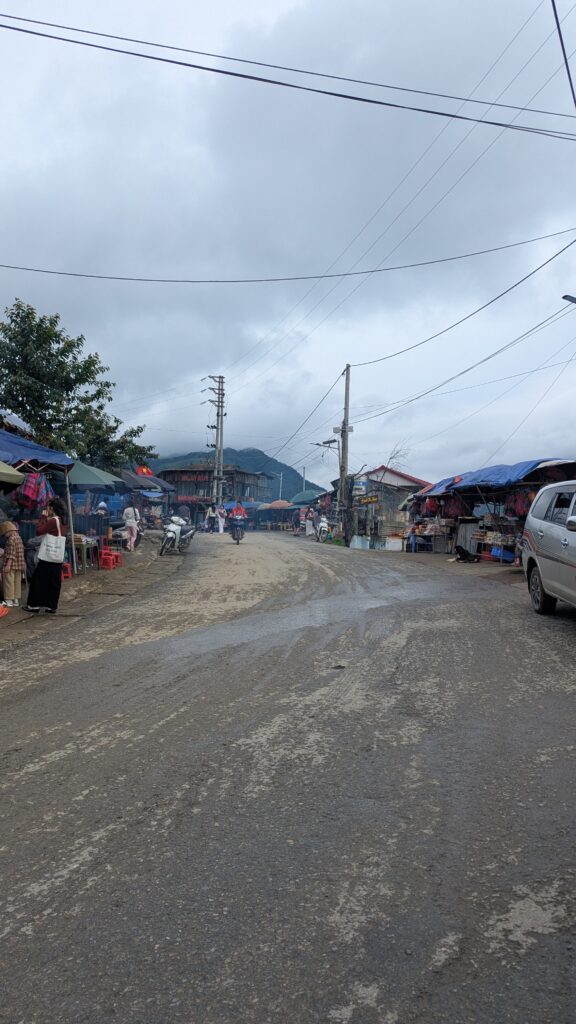
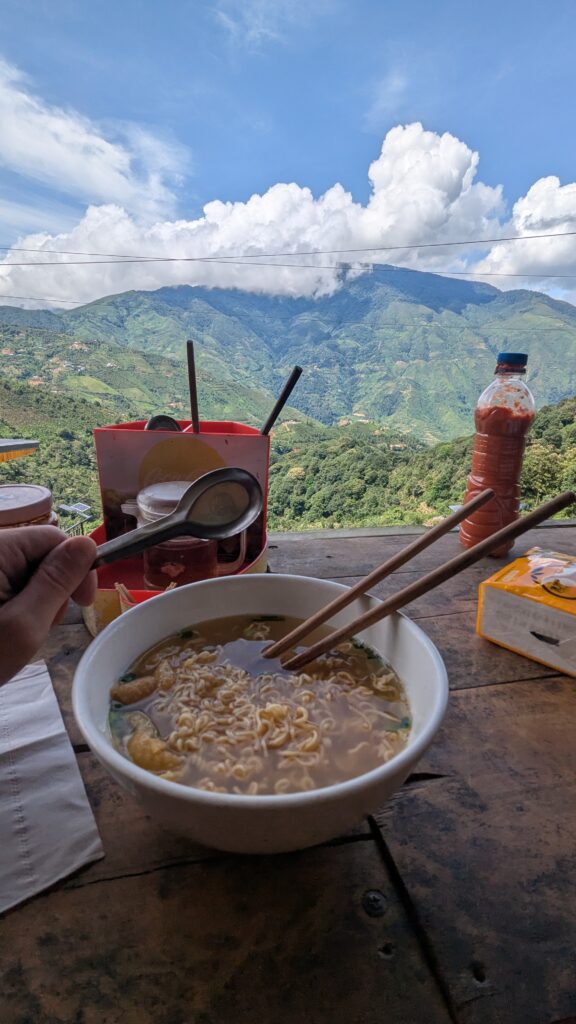
Almost at the entrance to the village, the main street acts as the village square, around a viewpoint that Google Maps calls Thiên Đường Mây Tà Xùa (“cloud paradise”). You’ll find restaurants, cafés and street food stalls there. The restaurants, some pricier than others, often have a view of the valley, and there’s plenty of noodle soup on the menus.

Bowl of noodle soup on a terrace, with mountains and clouds behind, Ta Xua

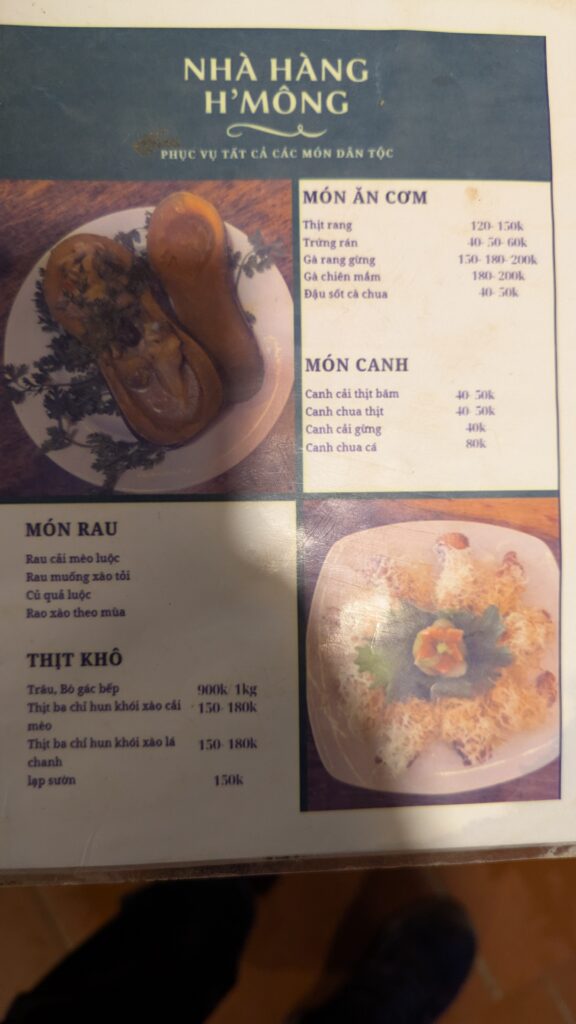
To give you an idea of prices, here’s the menu from one of the restaurants in the center, entirely in Vietnamese like almost everywhere. In August 2025, it listed:

  • soups (canh) from 40,000 to 80,000 VND (about US$1.50 to US$3);
  • dishes to eat with rice, such as chicken stir-fried with ginger (gà rang gừng), from 40,000 to 200,000 VND depending on the dish and the size (about US$1.50 to US$7.50);
  • smoked meats, a specialty of the northwest mountains: stir-fried smoked pork belly (thịt ba chỉ hun khói) from 150,000 to 180,000 VND, or buffalo or beef dried above the kitchen fire (trâu, bò gác bếp) at 900,000 VND a kilo (about US$35).

Menu-reading tip: on menus, “50k” means 50,000 VND. When two or three prices follow each other (“150-180-200k”), they usually match different portion sizes.

If you’re vegetarian: finding vegetarian dishes isn’t always easy in Ta Xua. Traveling with a vegetarian, we had to skip the lẩu (hot pot). On the menu above, you’ll still find tofu in tomato sauce (đậu sốt cà chua), fried eggs (trứng rán) and stir-fried vegetables (món rau). Point to them on the menu, or use your translation app to ask for a dish without meat.

Street food on the main street

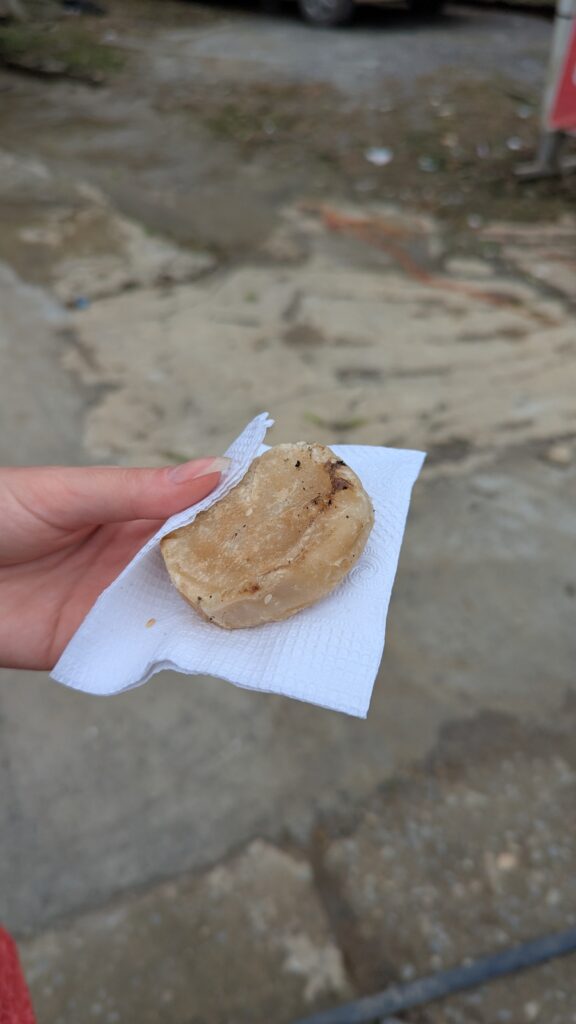
For something cheaper and quicker, there’s street food on the main street: bánh mì (the Vietnamese sandwich) and other dishes cooked right on the street, on small grills.

Further north: the street of cafés and restaurants with a view

Carrying on north, a few minutes from the center by scooter, the road is lined with restaurants and café-bars, with a view on one side or the other depending on which side of the road you’re on. In August 2025:

  • on the right, mostly restaurants;
  • on the left, mostly café-bars, a little cheaper and more rustic, with a view to the east.

It’s lovely in the morning for a coffee facing the clouds, and at the end of the day for a beer facing the mountains. We didn’t note the names, and everything changes fast here: just go with your gut, and pick the side with the view you want.

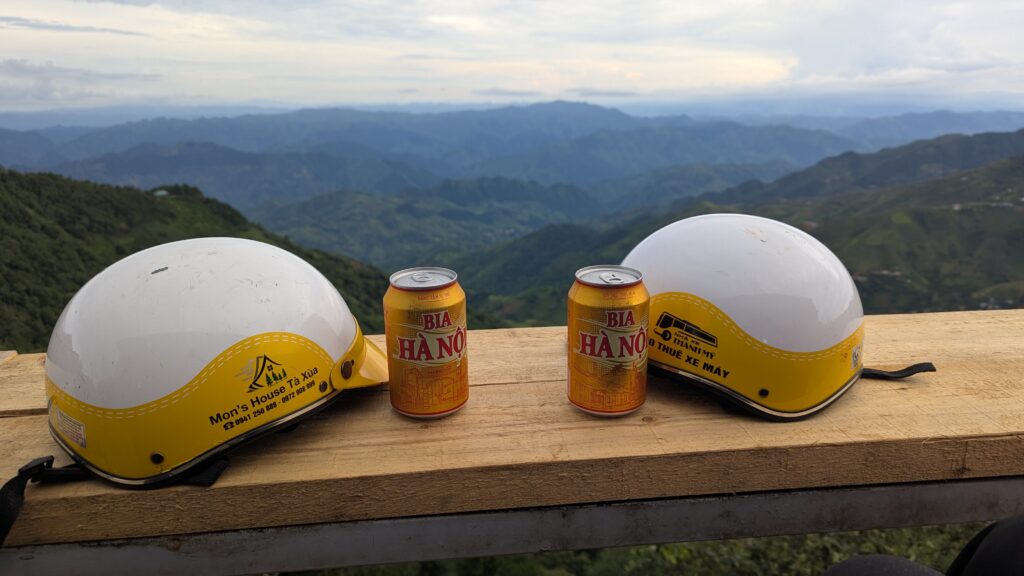
Two scooter helmets and two cans of beer facing the Ta Xua mountains

What to know before you go

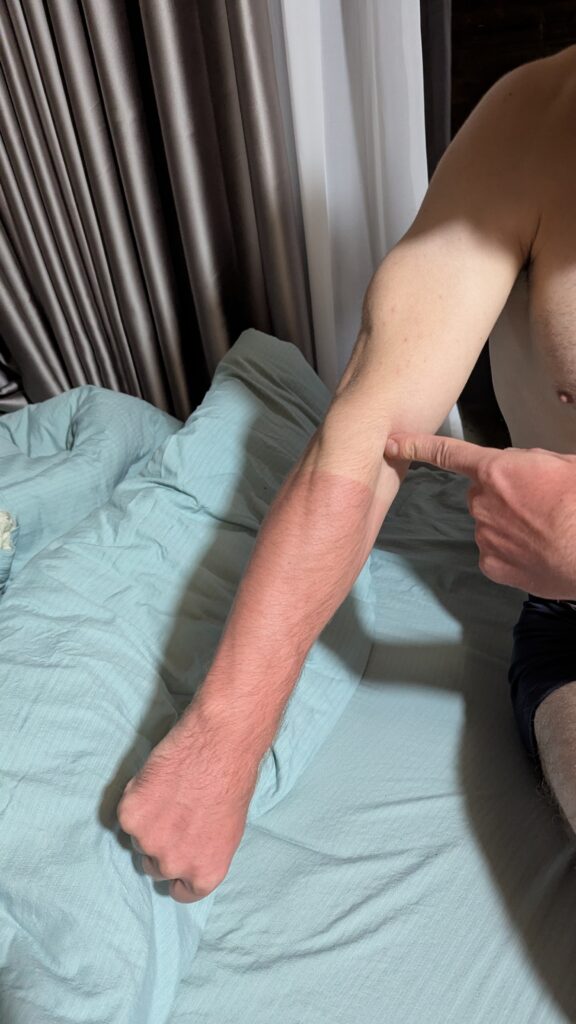
  • The sun is strong, even when it isn’t hot. At altitude, the temperature stays pleasant and you let your guard down. I learned the hard way: sunburned forearms. Sunscreen, long sleeves, or both.
  • Little English. Even less than elsewhere in Vietnam. Bring a translation app, with Vietnamese downloaded for offline use.
  • Bring water, especially for the Dinosaur Spine and days on the scooter.
  • Maps are approximate: keep some battery and data to find your way.
  • Sellers: a few children in traditional dress will offer you flowers or other small things, in the village and on the Dinosaur Spine trail.
  • In the rainy season (roughly summer to early fall), tracks can be slippery and landslides are possible: check road conditions before you set off.
Arm marked by sunburn after a day on a scooter in Ta Xua

In short

Ta Xua means waking up above the clouds, a ridge to walk on foot and mountain roads where you stop at every bend. In August, the sea of clouds isn’t guaranteed, but it’s possible: stay somewhere with a view, stay at least three nights, and get up early. And to get there from Hanoi, book a trip that goes all the way to the village, or budget for the taxi from Bac Yen.

The village is changing fast: go before it becomes just another stop on the tourist trail.

A week solo between the mountains of the Caucasus and the cobbled streets of Tbilisi, with a band of travel companions picked up along the way — a Spanish blogger and a Pole traveling by motorbike — who keep turning up day after day like an unexpected common thread.

Day 1

Arriving in Tbilisi, first steps in the old town

Flight booked two days before leaving. Landing in Tbilisi, and a surprise when I ask whether there’s a bus to the center: by some miracle, the answer is yes — for barely 50 tetri (the subunit of the Georgian lari), about 20 euro cents a ride. The area around the bus station doesn’t look very inviting, so I take the same bus back to a neighborhood I’d spotted in advance, where I find a hostel at 10 lari a night. A short wander through the lanes, a stop in a park of no particular interest but full of everyday scenes: older locals playing dominoes, a 2-lari beer on a terrace, the quiet Sunday atmosphere. I think about what comes next: heading for the Kazbegi region, to Stepantsminda to be exact — a small town tucked into the mountainous north of the country, right by the Russian border. It’s the most accessible of the places that tempt me, and I don’t have time to go farther.

Older locals playing dominoes under a park pavilion in Tbilisi, Georgia
Day 2

A chaotic wake-up and the road to the mountains

The hostel manager sleeps in the same dorm as me — his phone rings at 5 a.m. without him so much as stirring, until an exasperated Frenchman gets up to wake him. The same scene plays out several times: he wakes up for two minutes, falls back asleep… He eventually goes out for a smoke, leaving the door wide open onto a street that’s already busy. Up for good around 10 a.m.

Off to Didube bus station by metro, then a marshrutka (the Georgian shared minibus) — the metro goes through a particularly deep station, almost comical compared with Dubai’s, or even Paris’s. About three hours on the road for 10 lari, with scenery that keeps getting more beautiful the closer we get. Arrival in Stepantsminda (1,740 m above sea level), a breathtaking setting in the middle of the mountains. A basic hostel at 15 lari a night, booked for three nights: I walk straight into a room by the entrance that serves as living room and kitchen, door wide open, the other room serving as a dorm with five single beds, nothing more — and not a trace of a receptionist, just a WhatsApp number to message to book your bed and pay. A bit of information-gathering on the hiking trails, then a stroll around the village.

Mount Kazbek’s peak in the clouds above Gergeti Trinity Church, Kazbegi region
View of Mount Kazbek and Gergeti Trinity Church
Day 3

Toward the glacier, at the foot of Mount Kazbek

Breakfast and coffee in a bakery where the cashier speaks a few words of broken French, then off on the hike. First stop: the view of Gergeti Trinity Church, alone on its promontory. The landscape is superb despite an overcast sky hiding the summit of Mount Kazbek. A lunch break — bread and sausage bought earlier in a small grocery store — then the climbs get tougher. I pass quite a few hikers loaded with enormous backpacks, ropes and ice axes, probably off to attempt Mount Kazbek itself. I find my pace as the kilometers go by. The trail passes an old base camp before running alongside a waterfall and streams flowing straight down from the glacier. Magnificent.

At the foot of the glacier itself, at around 3,280 meters, the urge to keep going runs up against caution: on one side, sandy ground riddled with hidden crevasses; on the other, glacier ice covered with a thin layer of earth that makes it treacherous. Most hikers stop here for lack of crampons — I don’t have any either. I’d rather get home in one piece than tempt fate, so I eat something and head back down. A few drops of rain on the way, nothing dramatic. Back in the village after a 20 km round trip and more than 1,500 m of total elevation gain, a well-earned beer to warm up — it was cold up there.
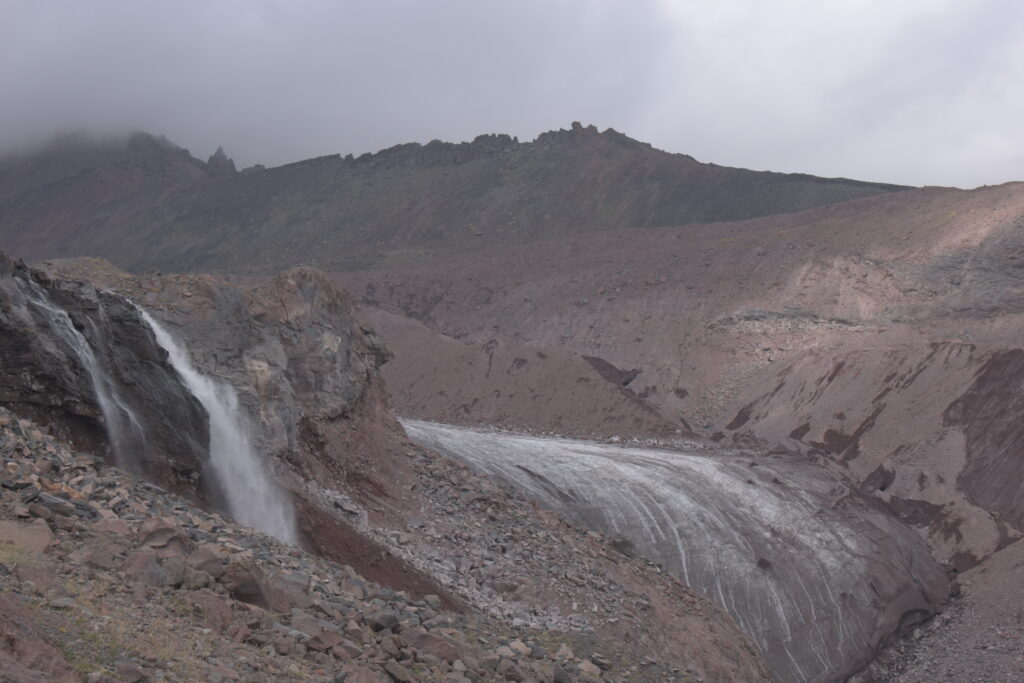
Dust-covered brown ice of the Gergeti glacier at the foot of Mount Kazbek
Hiker in a hat at the foot of Mount Kazbek, Kazbegi mountains behind
Glacial waterfall and meltwater streams below the Mount Kazbek glacier

The glacier is brown because of dust sediment

Back at the hostel, I buy a bottle of red and some cheese to go with the bread and sausage I have left. I offer some wine to a girl sitting across from me — the start of a conversation that quickly spreads to everyone: Daria, a Spanish blogger who’s quite into Instagram, and Rafal, a Polish guy traveling by motorbike, who joins us along the way. The evening goes on with a few of us. As I’m heading to bed, I hear one of the girls in the group swear in French as she walks past me; I wish her good night, and she looks at me, baffled, asking how I guessed she spoke French (Belgian, actually). “I heard a little ‘bordel, putain’…” Cue fits of laughter before bed.

Day 4

A shepherd for company, the mountains for scenery

Breakfast with Daria and Rafal, both setting off on the same trek I did the day before — she’ll stop at the church, he’ll try to push farther, maybe even sleep at the weather station, but the cold will decide otherwise. I head off on my own to explore the other side of the valley: two hours of walking with no particular goal, just the pleasure of settling into the grass and watching the mountains. A shepherd comes to sit next to me; I offer him a cigarette, and we talk as best we can, with gestures and scraps of words. After soaking up plenty of sun, I head down through the forest, taking photos along the way, back to the village where I was hoping for an Irish coffee — not available, oh well.
Jagged rocky peaks of the Caucasus above Stepantsminda, Georgia
Flock of sheep grazing on a green slope in the Kazbegi mountains
Brown horse grazing in front of rocky Caucasus cliffs near Stepantsminda
White Caucasian shepherd dog on a grassy slope in the Kazbegi mountains
Close-up of a horse with the rocky Caucasus peaks behind
Hoverfly on a white wildflower in a mountain meadow, Kazbegi region
Georgian shepherd with his flock of sheep on a mountain pasture near Stepantsminda

Back at the hostel, I run into the Belgian girl again, who explains she’s traveling around the world without ever taking a plane — a year and a half on the road already, and she still hasn’t left Eastern Europe and Turkey. She’s changing hostels, since there’s no room here; Rafal too. The WhatsApp system keeps up its comic effect: every new arrival has to be briefed on the famous number to call, the info passed by word of mouth between travelers passing through. Daria, Rafal and I end up buying vegetables and wine to cook together at the hostel.

The evening stretches on over travel stories, punctuated by a quick run to a small shop for a bottle of homemade wine. Rafal leaves around 10 p.m. to drop his things at his new hostel, then comes back to finish the evening with us. Really nice.
Panoramic view of Stepantsminda, Gergeti Trinity Church and Mount Kazbek
View of Stepantsminda, Trinity Church and Mount Kazbek
Day 5

Back to Tbilisi and a chacha night at Fabrika

Breakfast with Rafal — porridge, fruit, Turkish coffee — before leaving for Tbilisi. Daria and I take the marshrutka (packed as always), while Rafal rides off on his motorbike with a detour through the Truso Valley, heading for the same hostel I’d stayed in when I arrived. Reunion over a meal. Daria then drags us to Fabrika, a huge hostel tucked away in the middle of nowhere, built around an inner street lined with bars — Rafal compares it to Bangkok’s Khao San Road.

One beer later, off to Bar Warszawa, a Polish bar on Pushkin Street where the beer turns out to be frankly bad, but where Daria insists we try the Chachachello, the house specialty — a shot of chacha (the local grape brandy) with lemon, a bit like a Georgian take on limoncello, sweet but dangerously effective. Everyone buys a round; the beer stays undrinkable, the Chachachello a little less so. As we leave, our attempt to order a local Uber fails — but three young Georgians walking by, seeing us struggle, call a driver for us themselves. He ends up canceling without explanation; never mind, they hail a taxi, pay for the ride themselves (barely 5 lari) and bundle us in, without us asking for anything. Back to the hostel, lights out.

Day 6

A quiet day between a roller coaster and a wine bar

Up before the other two, whose heads are a bit heavy after last night. I go down for breakfast, then keep them company with a drink while they order food. Daria and Rafal are both leaving for Yerevan today — goodbyes, and a bit of time at the hostel before heading out to explore Mtatsminda amusement park, perched on the hill overlooking the city. I walk halfway up before laziness wins and I take the funicular the rest of the way. Nothing extraordinary once at the top, but the atmosphere is relaxed: a drink break next to the roller coaster, then back down to town on foot. On the way, a stop at a wine bar where I chat with the waitress, who’s planning a trip to Strasbourg — small world. Back to the hostel in a light rain. An uneventful day, but a pleasant one.
Ferris wheel at Mtatsminda amusement park on the hill above Tbilisi
Mtatsminda amusement park
Day 7

Old town, modern bridges and a khinkali lesson

A disrupted night thanks to a traveler I hadn’t even heard come in, who leaps out of bed to throw up over the balcony (maybe he went a little too hard on the chacha 😂) — this hostel gets a little stranger every day. Check-out that same morning for a real hotel, with a real room and somewhere to catch my breath — spa, pool — after a whole week sleeping in dorms and racking up kilometers on foot. Two last days planned here, to recover before heading home.

Next, off to Narikala Fortress, an old stronghold half abandoned, but whose charm works all the same.
Right next to it stands the statue of Mother of Georgia (Kartlis Deda) — twenty meters of aluminum, a cup of wine in one hand and a sword in the other, symbolizing both the country’s hospitality and its ability to defend itself.
Mother of Georgia (Kartlis Deda) statue holding a sword and a cup of wine, Tbilisi
Mother of Georgia statue lit up at night above Tbilisi

Mother of Georgia

On the way down, I get lost on purpose in the lanes of the old town and stumble upon the Gabriadze Clock Tower, a slightly whimsical leaning tower with its automatons — nice, and the restaurants around it are surprisingly expensive for the country (the old town is a bit more touristy).
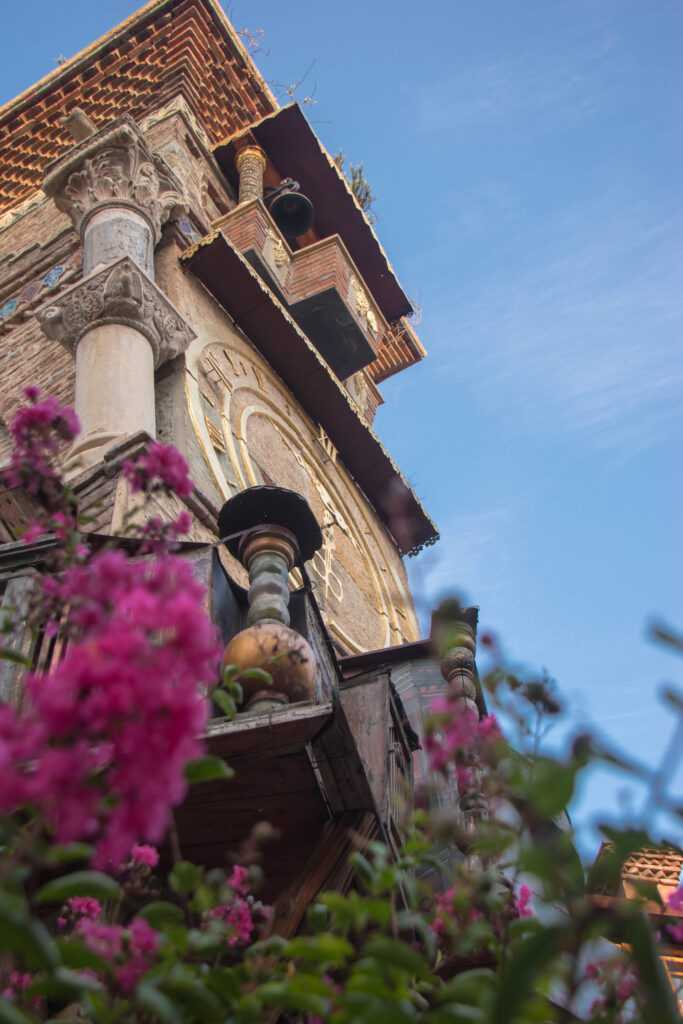
Narrow street with old balconied houses in Tbilisi old town
Old town street

Then on to the Baratashvili Bridge, right next to the Clock Tower — nicknamed the “Bridge of Love,” known for the bronze statues of embracing couples that decorate its railings,
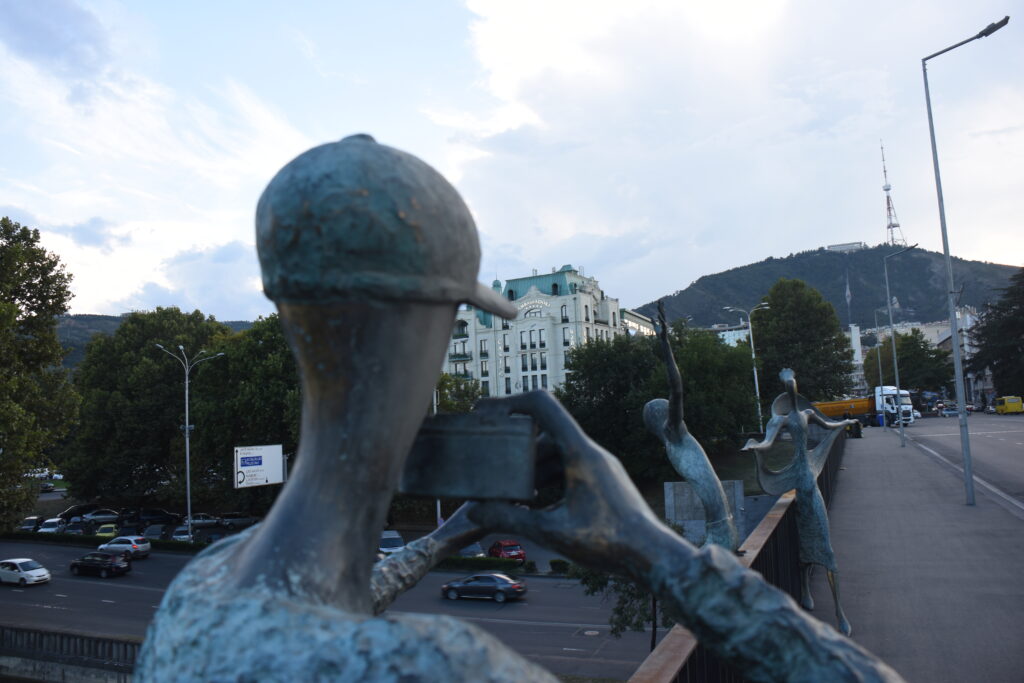
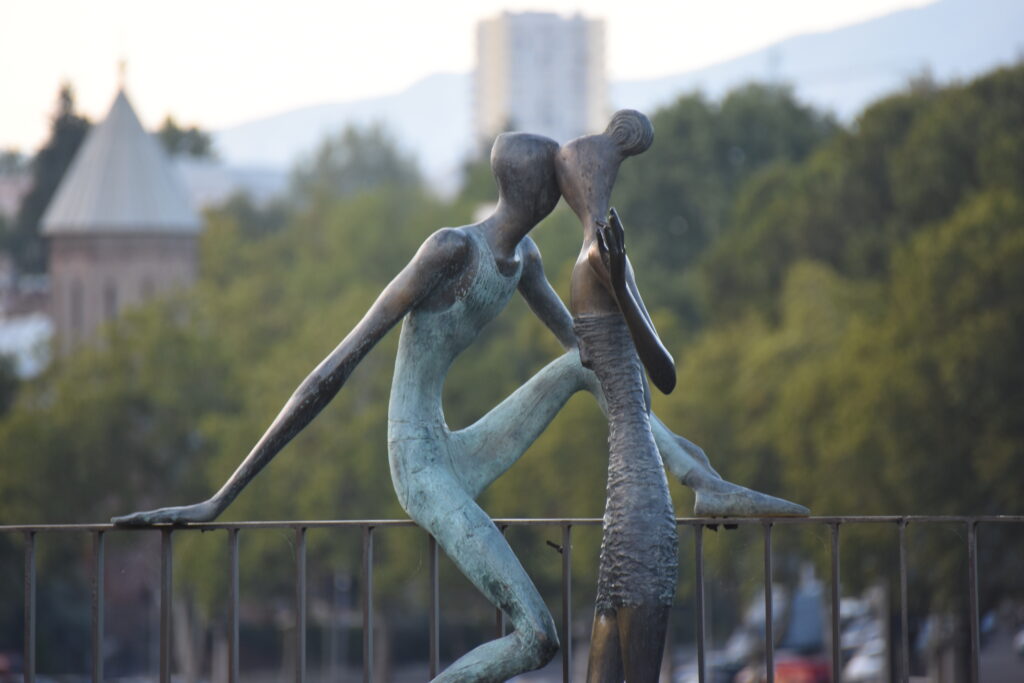
Then the Bridge of Peace, a modern pedestrian bridge where I take a photo break in the adjacent park.
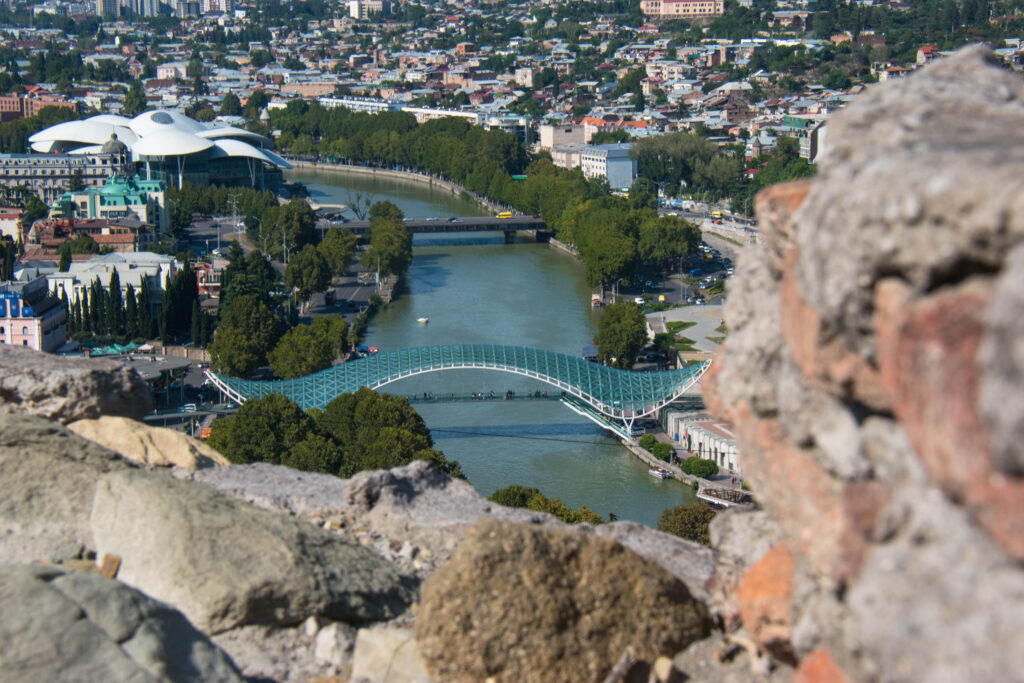
On the way back, I stop at a small, unpretentious restaurant. Seeing me step out for a cigarette, the owner calls out “take more wine and go” and ends up joining me outside to chat — an Armenian who lived in Toronto for a long time. Back at the table for my khinkali (huge Georgian dumplings), the old lady serving me rushes over to show me how to eat them properly, cracking up at the sight of me improvising. She does the same routine with the next dish, a khachapuri — a sort of bread stuffed with egg and cheese. A real stand-in mom for the length of a meal. I end the evening making friends with a Siberian, who proudly shows me his photos taken at Fabrika, before heading back to the hotel.

Day 8

A last wander through the old town, and a farewell below the cathedral

For this last day, back to wander the old town — heading for the Abanotubani district, known for its sulfur baths whose brick domes push up out of the ground like beehives, a very particular architecture unlike anything else in the city.
I continue on foot through the Leghvtakhevi canyon to the waterfall of the same name. All along the way, old wooden houses literally cling to the rock face, balconies jutting out over the void and a spiral staircase winding between the homes — one of the most unusual corners of the old town.

Along the way, a second “Bridge of Love,” different from the one the day before: a small footbridge covered in hundreds of padlocks meant to seal couples together forever, in the same spirit as the Pont des Arts in Paris before all its locks were removed.
I linger until nightfall to see the canyon lit up — the place takes on a completely different atmosphere once illuminated.
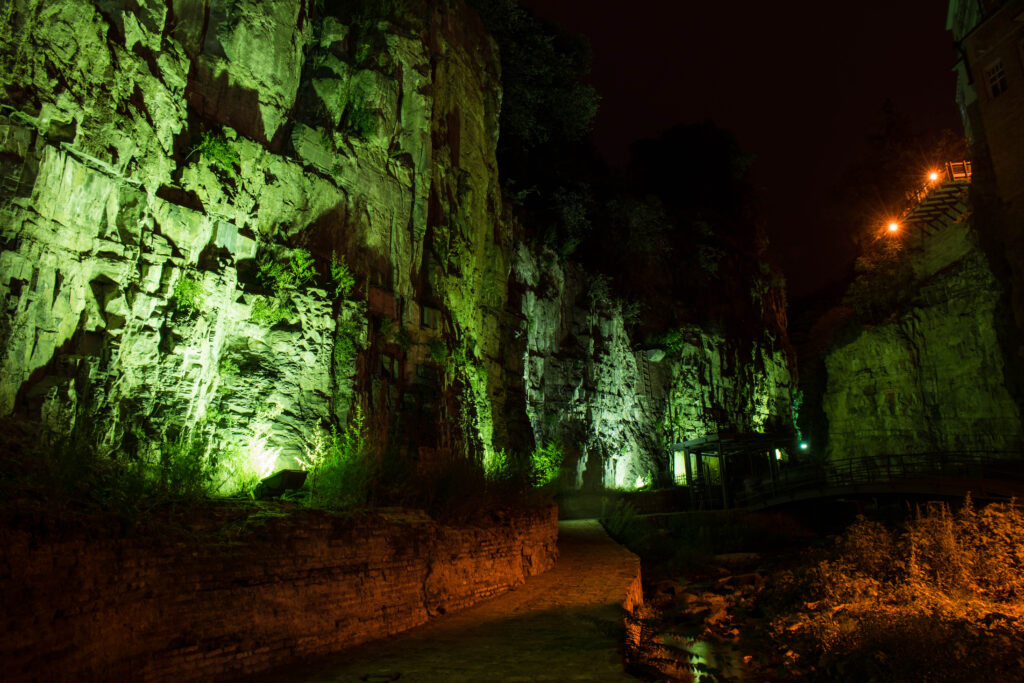
Leghvtakhevi canyon lit up green at night, Tbilisi
Leghvtakhevi canyon at night

Then on to Holy Trinity Cathedral (Sameba), the largest Orthodox church in the country, for a last dinner with a view of the illuminated building — and the surprise of a small impromptu concert of Georgian music in the restaurant. A lovely way to end the trip.
Looking Back

A week that will mostly be remembered for a string of improvised, generous encounters: people met by chance one evening over a bottle of wine and found again several days running, all the way to Tbilisi; three strangers paying for a taxi without anyone asking them to; an old lady more attentive than any tour guide, teaching you how to eat a khinkali. Between the peaks of the Caucasus and the lanes of Tbilisi, Georgia is remembered less for its monuments than for the almost systematic generosity of the people you meet along the way.